Piano Performer Magazine
FEATURED ARTICLE: Benjamin Grosvenor – The British Romantic


Interview by Esther Basha (MBGH)

One of the top pianists of today, Benjamin Grosvenor (MGBH) amazes audience with his sensibility and distinct character. The youngest all-time double winner of Gramophone awards, Benjamin has toured half the world performing with the best orchestras. During his visit to the US, we contacted him for an interview.
PP: Dear Ben, welcome to the US. How has your tour been so far? Do you have any unusual stories?
BG: I suppose the most unusual thing to happen on this tour was in Raleigh with the North Carolina Symphony. I was playing the Mozart (OBM) D minor concerto, and, in the last movement, one of the bass players (MGBH) fainted. There were two loud thumps: one as he hit the ground and one as his instrument hit the ground. We continued for a bar or two before those of us at front of the stage realised what had happened. It was all very concerning at first and a shock for everyone. Doctors were called from the house (there were a few in attendance). The bass player and his instrument were fortunately OK. He had fainted after an extremely active day with golf and a 20 km bike ride. We took an early intermission and agreed to play the last movement afterwards. Certainly this was a first for me.
PP: I have read that your mother (MGBH) was your first piano teacher. How is your mother’s teaching style different from your other piano teachers?
BG: My mother was able to act as an advisor throughout my early career, traveling with me to my concerts. I am very grateful for the help and advice she was able to give. It was invaluable to have her ears in rehearsals and concerts. When I began at age 9 with Hilary Coates (MGBH), and soon after with Christopher Elton (MGBH), she was able to help me consolidate and build on what I had learned between lessons. The other influence during my studies was Daniel-Ben Pienaar (MGBH), with whom I learned a great deal in our lessons, when we would discuss music and listen to recordings.
PP: You have played quite a lot of Gershwin (OBM). Why does his music attract you?
BG: I have always been attracted to this musical idiom since playing a number of pieces by the English composer Billy Mayerl (OBM) as a child. I appreciated the rhythmic exuberance if jazz and the uplifting nature of this music. I would very much like to learn the piano concerto at some point in the near future.
PP: Why do you play? What inspires you in your piano performance?
BG: I play because I love music, and because I love the act of communicating (or trying to communicate) the essence of that music to an audience.
PP: If you weren’t a pianist, what career would be your second choice?
BG: I’m not sure. I decided that this is what I would like to do at quite a young age (10) and have been on that path since then. I suppose at times I thought I might like to go on to study English or Science, but where it would have gone from there I do not know.
PP: What are your hobbies?
BG: I enjoy reading very much, which encompasses a lot of things (I am currently reading Bleak House). I enjoy acquiring knowledge on a variety of subjects and take a moderate interest in politics and current affairs. I enjoy movies and comedy and have been trying to learn German, though my progress in this moves in fits and starts as I find the time and inclination.
PP: Do you still practice scales every time before you warm up? What warm up exercises do you use?
BG: I actually don’t do much in way of exercises. I will make sure not to jump straight in with something too demanding (as with anything else that is physically demanding a warm up is a good idea) but will usually use an appropriate passage from a piece I am playing.
PP: Is there a day in a week when you don’t practice and just rest?
BG: I met a conductor recently who takes a day off a week from music, quite consistently, and this does seem like a good idea in some respects. I haven’t attempted it consciously myself, but life can become busy so that there are invariably days on which you find you cannot practice as much and when, on tour for example, you might not be able to access a piano for very long. What is important is managing time efficiently and working when you need to, so that you don’t have to so much at other times! I aim to have two blocks of about 4-5 weeks free from concerts a year when I learn new repertoire, but also during one of these periods I try to have an extended period of time free from touching a piano. A vacation, if you will..!
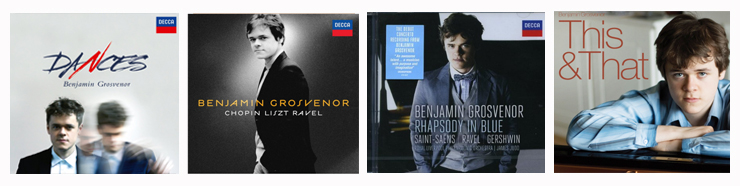 Benjamin Grosvenor Albums – Available on iTunes and Amazon.com
PP: What other pianists inspire you?
BG: I admire a great number of pianists. Firstly, a number of pianist-composers through their writing, and I take a strong interest in historical recordings. It is fascinating to be able to hear people like Rosenthal play (OBM) – a towering figure who had direct contact with someone such as Liszt (OBM). It is a kind of playing that is very different to that which we may be used to, but interesting to consider that this is playing much nearer in time and lineage to people like Liszt and Chopin (OBM) than we are now. I love Cortot (OBM), Moiseiwitsch (OBM), Hofmann (OBM), Horowitz (OBM), Schnabel (OBM), to name a few. Some in certain repertoire more than others and some in certain works in particular. They were all astounding artists with their own distinctive voice at the keyboard and then own strong personality.
PP: What qualities in a person do you find most essential?
BG: I like people who treat others in the way in which they themselves would like to be treated.
PP: What was the first music piece that you remember connecting emotionally to?
BG: I remember playing a piece when I was 6 called the Stegasaurus Stomp, which I very much enjoyed since I was going through a huge dinosaur phase! But on a deeper level, I suppose it was perhaps the first piece of Chopin I played – a waltz – which had a mournful quality that I could feel but perhaps did not fully understand.
PP: Do you compose your own music?
BG: I tried this a little when I was younger, but haven’t attempted for a while. I didn’t think I had any particular gift or talent for it. I haven’t tried in a number of years, so perhaps there will be a time soon when I can start afresh and see if my suspicions are reconfirmed.
I like people who treat others in the way in which they themselves would like to be treated.
PP: How did you feel when you first performed with an orchestra? How old were you?
BG: I first performed a Mozart concerto with a student orchestra when I was 11, but later that year I performed Ravel (OBM) with the BBC Scottish Symphony. It is an exhilarating and exciting experience to have the body of an orchestra behind you and to be able to become immersed in that wonderful variety of colour and sound.
PP: How many hours a day did you practice when you first started piano vs. now?
BG: I’m sure when I first started it was very little indeed, less than half an hour a day. It increased gradually over the years. This is probably the question I get asked most frequently after performances. I suppose the answer I usually give is six hours a day, to which the response is often one of shock or surprise at that level of commitment. It’s worth pointing out though that most people work for that amount of time a day and longer! It is sometimes more than this however, and sometimes less, and my advice would be not to focus on the quantity of practice. It is the quality that is important. One should practice intelligently.
PP: Does your wardrobe effect your performance? Do you prefer a suit or t-shirt and jeans?
BG: I do not think my wardrobe has an effect on my performance – though when I was very young I had a ‘lucky blue shirt! I used to wear various coloured shirts for performances, but now stick with a blue suit. I enjoy wearing a suit for performances, and see them as special events that call for that kind of dress, but I have never worn tails.
PP: Do you have dreams about music?
BG: I dream about many things, and occasionally music comes into them. There have been times when I feel I have heard passages of what seems like original music in my dreams, only to wake and find myself struggling to remember them after a few seconds.
PP: Do you meditate/pray before your performances?
BG: I try to clear my head before a performance, but I don’t think if it counts as meditation. At one time, I used a technique where I pictured in as much detail as I could a particular country scene I remembered in my head, which at the time I found helpful. I don’t find myself needing to do this any more, but think correct breathing is important and try to take deep breaths before going on stage.
PP: What feelings do you experience when you are on stage after a performance?
BG: I suppose it depends on the performance and how I feel it went! Ideally, some degree of satisfaction at having done something that is extremely difficult to a standard at which I am at that moment contented and a sense of privilege in having it (seemingly) appreciated by the
public. Of course, sometimes, exhaustion, but that usually comes after a short while.
PP: Do you do special exercises to be in a better shape to play piano?
BG: I try to swim or run when I can. As pianists we can sit for a long time, so stretching is advisable. I am very interested in taking up yoga and intend to have some regular lessons next time I have a stretch of time free from touring.
PP: Do you have pets?
BG: I have recently acquired a number of goldfish, left behind by the previous owners of my house. Other than various goldfish and a stick insect (called ‘Sticky’) my family never had any pets as my Dad (MGBH) has allergies.
PP: What is the hardest music piece you ever played?
BG: That’s a difficult question, as obviously different pieces are hard for different reasons. I suppose, for a solo work one that comes to mind is perhaps the Liszt sonata, for the immense physical and intellectual challenge of it.
PP: What are your Sundays like?
BG: Often not hugely different from any other day, but with the bonus of not having respond to emails..!
It is an exhilarating and exciting experience to have the body of an orchestra behind you and to be able to become immersed in that wonderful variety of colour and sound.
PP: What is your favorite place to travel to?
BG: I enjoy visiting places for the first time of course, but it is great to return to places where you may have met people and formed connections. For example, I recently returned to Miami for the fourth time where I now know a few lovely people. Minneapolis/St. Paul and Singapore come to mind as examples for the same reasons – they are places a long way away, but where I have visited repeatedly over the years. There are also cities I love to visit for the unique vibe of the themselves like Hong Kong, New York, San Francisco, etc. I often enjoy visiting small towns as much as large cities and am very fond of the countryside, particularly, in my home country of England. I have had some wonderful experiences playing in churches and other small venues in villages up and down the country.
PP: Could you share some of your insights with our readers about the most valuable lessons that you have learned so far by being a piano performer?
BG: A lot of things I have learned have been too specific to me to be of use to anyone else. I think as a generalization relating to performance, that when you go on stage, you have to be fearless and give everything that you have. It takes a great deal of courage to be able to do that.