Piano Performer Magazine
THE HINER METHOD


Interview by Esther Basha (MGBH)
Friendly spiders, Mr. Oops, colorful butterflies, cute mice drinking tea at Princess Tonic’s palace. All this is a magnet for toddlers whose eager parents are on a quest to raise XXI century Mozarts.
Based on the Hiner method, this computerized piano learning system consists of 6 (six) games and a music repertoire curriculum. Its name reflect the target result – SoftMozart.
Add to it an international community of excited parents who share performance videos of their styles, with Hellenistic Hiner herself awarding butterflies for top performance, and you will get a perfect environment for learning piano at home on a budget.
Intrigued with the idea of SoftMozart, we met with Dr. Hiner (MGBH), a renowned musicologist and pedagogue, to learn more.
PP: Dear Hellene, please, tell our reads how you became interested in teaching music and why.
HH: It happened in May of 1976 after my graduation recital in music school. I received A+ for my performance first time in 7 years of study piano. For years I struggled learning how to play piano and read music, but became a prodigy a year before graduation. My enthusiasm to learn why so many beginners fail music education and what should be done in order to change the situation became my passionate priority in life.
PP: What is the philosophy behind your method? And what is the core of your teaching method?
HH: We all know how important music education is for young children. In this regard, I share the same philosophy with majority of my colleagues that every individual should have music education. All children are gifted, and our goal is to ignite their best potential with music. However, we are all humans and our perceptions and physiology has its limits and restrictions. For example, our eye is built in a specific manner, and we first learn how to focus on one object at a time and only after that are capable of shifting focus among the lines.
For this exact reason, all written languages on Earth are linear. Music notation is completely different. First, it is multi-linear; second, spaces are not just ‘breaks’ between the lines. They are tracks of information too. It is quite difficult for beginners to follow up with all these tracks. Add to this equation time measurement and duration, and we have a problem: we have to use theory and a lot of cramming.
Interestingly enough, at the beginning of XX century we had almost the same struggles with teaching beginners to read books using Bible or Psalter. I found this fascinating. When alphabet with pictures was invented, everything turned around towards successful learning. Placing a picture next to abstract note became the game changer!
I created the same approach for music literacy: we offer different formats of music text from elementary to original and let our students use the most comfortable for their visual perception. We have formats similar to picture books, chapter books, and novels. It gives teachers and students flexibility and ability to maneuver. We do not adjust a student’s eye to a rigid text format.
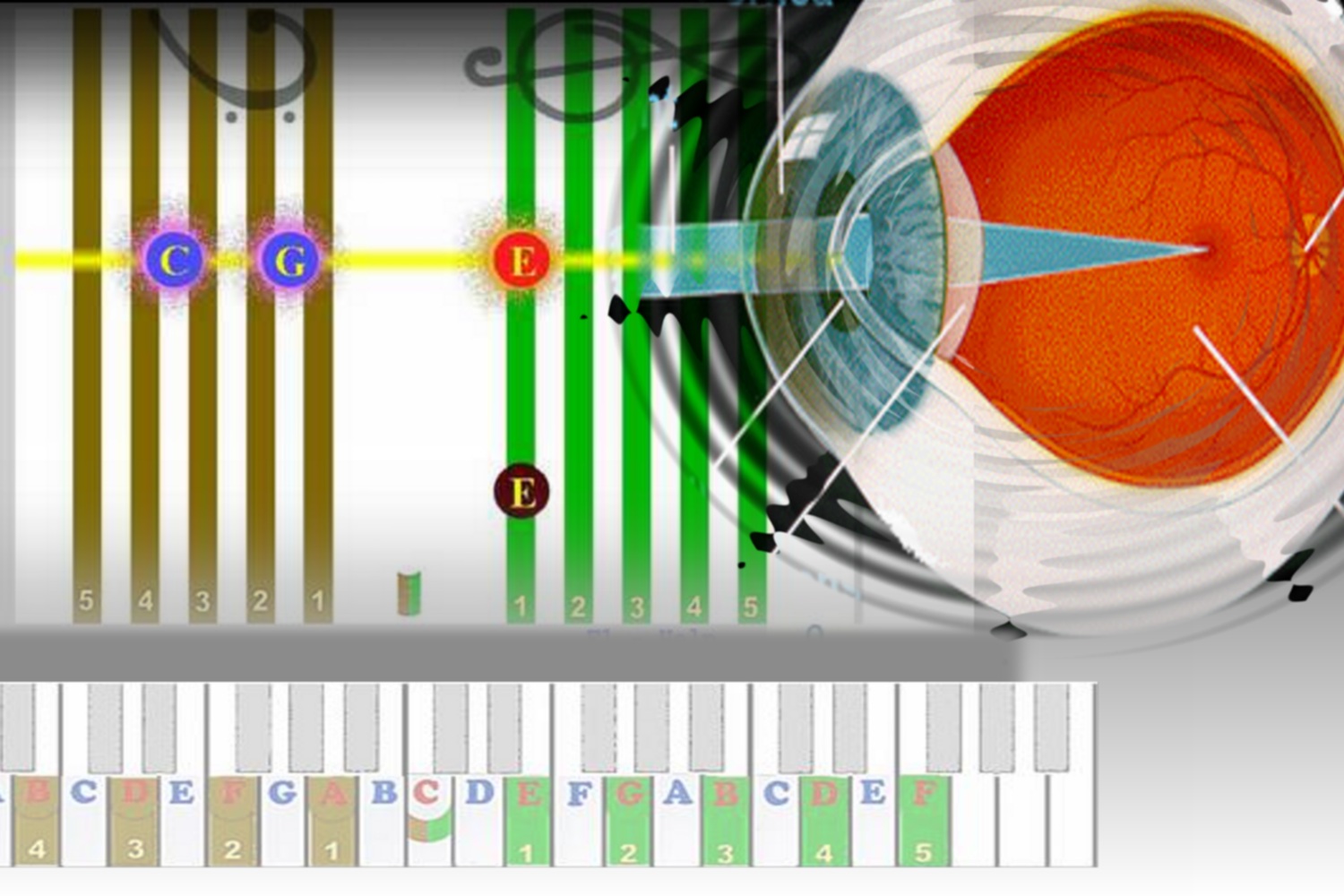
Instead, we transform text format to the student’s visual perception and gradually develop his vision to read music notation like a professional. Visually the piano keys, lines, and spaces of the Grand Staff are the same unit. It is so bold and simple that every child can intuitively follow as ‘monkey see – monkey do’. If we start teaching like this, every child should learn how to play piano and read music from the Grand Staff as starting point of his/her music education. By active involvement in music making through sight-reading, children develop their musical talents and later in life can apply their music literacy to different music instruments and activities. If we can make it happen, we will raise a new generation of people who will be smarter, more balanced, and make music literacy global.
PP: What is the earliest age, in your opinion, for kids so start taking piano lessons?
HH: 24 months and up. Some of my trainees showed amazing results even with younger ages, but 24 month is about average age for piano lessons. Children of this age already craving activities that involve their fine motor skills and music production. They can control each finger and coordinate both hands. There are billions of neurons in their brains that had better be used then lost forever. Pediatricians suggest working with small objects – with play dough, for example. I think, playing piano is the best activity for the most effective fine motor skills booster of early learners. They develop their minds, learn to use all fingers, develop hand-eye coordination, both hands coordination, music ear, voice, music memory. We kill way too many birds with one stone by starting with my method early in life.
PP: What came first: your method or software idea? Is it possible to teach with Hiner method without software?
HH: The method came first. I came up with the games, exercises, and vertical sheet music long before the software was incorporated into my teaching system. Software added more interactivity to what was initially developed. Interaction is the most important component of successful learning.
For example, Leopold Mozart (OBM) was 24/7 interaction for Mozart (OBM). When one learns something new, one feels better and develops faster if one receives immediate feedback. Materials that I created gave learners such information, but was not 100 % intuitive as they are now. In some countries my method is being used without software for financial reasons. Now computers and digital pianos are less expensive, and people prefer to teach with software. I suggest using software for the most effective results.
PP: Does one need a teacher in order to work with your method or is it possible to learn piano on his/her own?
HH: You will find the best answer to this question in our history of learning how to read. Does a child need a teacher to learn letters of the alphabet? Many do, many manage on their own. However, we all go to school to improve our reading skills. After that, some become writers, some readers, some actors. For that we need special training. The same applies to learning piano. I have homeschooling families that couldn’t afford piano teachers. They learn by following my lesson plans and interact online with other teachers. The more they achieve, the more they need private instructions. Of course, it would be ideal to start my method with a certified piano teacher. This is the best combination possible! We have winners of piano competitions in Spain, Ukraine, and Israel. All the winners started SoftMozart with certified teachers.
PP: What was your goal/objective in creating the software?
HH: My method is about active learning, hands on experience, building concrete applicable skills. Objectively, computer + piano is the most effective training tool for gradual skills development. Piano keys are like buttons of a spaceship. It requires many different complex skills to navigate them with ease. We have special software – flight simulators – that teach pilots to fly. This software was built with similar intention.
PP: How can a piano teacher work with your software? What is its benefit vs. Traditional lessons? Does a teacher require training in your method or is it enough to read the book?
HH: Working with the software is simple. Piano teachers can find regular repertoire that they use for their lessons. The fun starts when they can give their students additional options to play the pieces with different font sizes, with or without colorful prompts. They will be able to offer different options to make music reading and memorization the most enjoyable and fun experience.
We have some animated characters that provide learners with intuitive hints about everything: how long to hold a note, how to develop legato, is the note right or wrong, how to fix a mistake, what the time delay in playing piece is, etc. Students and their parents will be pleased to feel in control of homework progress. With my method, teachers are no longer ‘mistakes registrars’. Computer is doing this job. Instead, teachers utilize their lesson time for professional work: helping with mastering the technique and art of performance.
Teachers love SoftMozart, too, as it frees up their expensive time from the tedious technical work and allows them to focus teaching the art of playing piano.
PP: Can one learn to play piano using only acoustic piano with your method?
HH: Yes, but they won’t be as successful as those who also use the interactive component that a digital piano or keyboard with a computer provides. Our students perform and polish their artistic performances on acoustic instruments, but learn to play pieces with the software. It saves a lot of time and energy. It is similar as use of computer for typing the interview VS writing it on paper with a pen. Of course, writing with a pen came first, but spell check, ability to correct mistakes, change formats, etc. make computer typing more fun and enjoyable.
PP: Where is your SoftMozart mainly used?
HH: SoftMozart is used everywhere where we teach music: in private piano studios, in public schools, at homes, in group and individual lessons, in day care centers, and in homes. We currently offer the software method in English, Russian, Spanish, and Kazakh languages. Getting ready to translate it to German, Italian, Japanese, Chinese, and French.
PP: What issues, in your opinion, does your software solve?
HH: The method and software can completely solve the sourest problems of music education in America. First of all, it gives the opportunity to start music education from 24 months on the mass level. Imagine, how many educated listeners, smart students will come to elementary schools? By the age of 6 they will know what instrument they prefer to play. In fact, piano is just a starting point for music education in this regard. The cost of such education will be affordable for each family. Moreover, such classes can be provided in day care centers. Piano labs can easily replace lessons about music. After graduation, students will have applicable skills. Classical music will become popular in society again, and recitals and contests will involve more people. Creating music is an excellent alternative for playing computer games and surfing the Web. It is a wonderful social tool that children love to have especially when they becoming teenagers. It means also that they will use their energy in a creative, positive way. And by spreading music literacy overall, we can bring more prodigies to our professional teachers. In addition, we create millions of educated listeners that will appreciate the talents of the prodigies. Finally, the music education will start shining and make everyone happy. Today, due to the high cost of the piano lessons, we teach only those who can afford them. For the same reasons, we unable to teach many subjects that a well-rounded music education requires: solfeggio, ear training, chords, music dictations, transposition, music theory, etc. My method and software solve many (if not all) of these problems. The curriculum gives students well-rounded and affordable education.
PP: What are your plans for SoftMozart for the next five years?
HH: I plan to complete an online training course for music and piano teachers (currently I have to train teachers 1 on 1, and it is time consuming and very expensive). This will drastically decrease the cost of training and certification. Piano teachers today are not appreciated enough. We have to do everything to help them expand their businesses and to make their hard work highly recognized by society. I think, with my method we can achieve this goal and give piano teachers plenty of new opportunities and students. Of course, my goal also is to create more tools for educators to make their experience most enjoyable. There are new features and games, more piano pieces and duets, better technology and lesson plans in line. I have a goal to collaborate with educators in order to bring the system to the public schools and colleges, planning to approach day care centers and special needs children facilities to spread the system anywhere possible. I is the win-win situation for all to have it. Of course, we will expand the relationship with homeschooling community and continue working with current trainees from different countries.
PP: On your SoftMozart.com website I saw a “community” tab. What is it all about?
HH: We have an online community of teachers/parents, where we share our experience, find help and support, provide different contests, recitals, progress diaries. My method is very young, it is still in development stage and we – members of the community – have a unique opportunity to be pioneers and see how children and adults learn with it, what they achieve, and how they do it. It is so much fun, when you watch videos of a 3 year-old-girl playing something elementary and in couple of years see the same girl performing Rachmaninoff (OBM) in front of the audience. You may go and watch all the milestones of her development and better understand the dynamic of her development.
PP: Does SoftMozart award scholarships? If so, on what basis?
HH: Yes. Our dedicated learners do not pay full price for their education. We have families on full scholarships. The only criteria is DEDICATION. We want to see disciplined, serious learners that follow lesson plans, learn, and participate in Academy and recitals. We provide recitals through YouTube twice a year: Winter Butterfly Ball (Dec15–Jan15) and Graduation (May 15 – June 15). Butterfly Ball is about quantity. I send all the participants as many butterflies as pieces played. This recital is planned to combat perfectionism and spread love for music making. Graduation recital is more formal and our goal is quality of performance. Children gets diplomas and gifts. Internet society helps us keep motivation going. Children are happy to perform, interested to see other performers, communicate, and receive gifts from Texas. I think, it works like a charm for creating music education awareness.
PP: How many hours a day/days a week do you recommend that students study?
HH: It depends on a student, his/her goal, and level of involvement. I usually recommend to work on piano the same healthy way as we take meals: very often, but in small portions.
With the intuitive aspect central to the method where kids learn through play, gaining knowledge and skill becomes its effortless byproduct.
PP: What other aspects besides piano performance does your software teach?
HH: Sight-reading, sight-singing, transposing, harmony, music dictations, music appreciation and music history, theory in form of interactive theory and Puppet theory (where different characters and their stories used as concrete explanations of abstract concepts. For example, Tonic is a Queen of music and her husband is a King Dominant. He is absent-minded and always asks questions. Tonic answers those questions. After watching such a story, students play D-T in different keys through my software. After that we give them explanation what different tonalities – Tonic and Dominant – are.
PP: What equipment does one need to use SoftMozart?
HH: Technically Soft Mozart doesn’t require much: any computer – Mac or Windows and any digital piano or keyboard. Keyboard should have at least 61 keys.
PP: Thank you, Hellene, for the interview. We hope many piano teachers as well as piano students will benefit from your method.