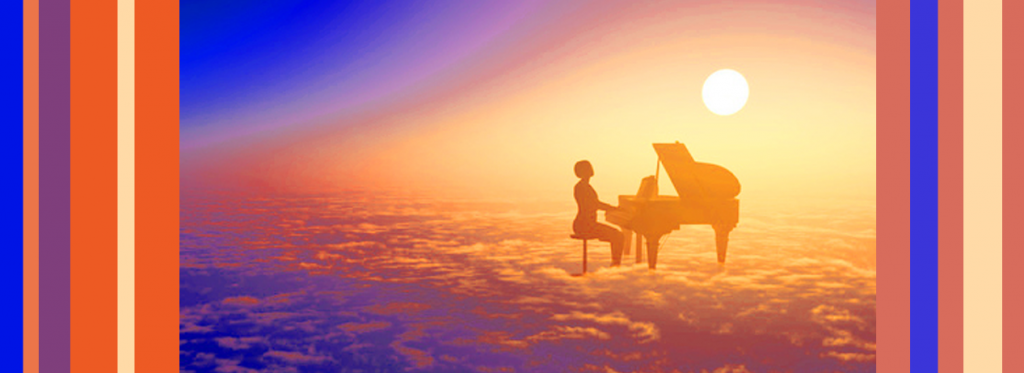
A little boy’s dream… takes him so far – Miles away from home. He follows the heart, He follows his art.
He spends hours… in solitude.. Practicing the piano. So that we could Listen to the divine sounds Of Mozart and Chopin.
Beautiful in appearance, Sensitive emotionally, He strikes us with originality Of his artistic performance.
His fingers play While his face talks to Invisible friends of Beethoven, The dancing fairies of Sibelius, And the characters of the suite of Prokofiev.
He smiles and laughs with them, He cries and prays for them, He dreams their dreams And shares visions of them with his audience.
May God bless you, oh, pianist! With the gifts you deserve And with those you don’t. May your soul fulfill The mission it came To accomplish In this beautiful world.
She looks at us from the screen And gives us the sweetest smile. She says, “Life is a present. Music is my religion, And piano saved my life.”
“How?” we ask her in awe. She pauses to tell us more.
“Growing up in Czechoslovakia In a family of musicians,
With Kafka, Mahler, and Freud as friends How much more prestigious Could our status be In that secular circuit of Intellectual….. Jews….
My older sister Irma, my first piano teacher, Awakend in me that unstoppable itching To be a musician, the best one I could With Arthur Schnabel affirming, “You should!”
Fastforward, my pianist career took off, With concerts in Prague and Dusseldorf, My family life was a dream come true: A loving husband and son – both Jews…
But paradise, only everlasting in heaven, Was interrupted, disrupted, destroyed. Where is my Gan Eden?
Instead, alone with a child in a cattle train For Teresienstadt to become my terrain.
But something inside me Whispered, “Don’t let go.” Or, maybe, the look on my son’s face Told me there was hope.
As long as I had him Next to me – in my arms, I was happy, and so was he, And we had a few laughs.
Then a miracle happened – I was asked to perform. Heavenly waters emerged from a perfect storm.
They asked, “ Do you play music? Can you perform for the Furher? Myself and many other musicians Said, with reluctance, “Sure…”
Reluctance, mixed with excitement – We shall survive! That’s how piano saved my life.”
She pauses…. With a dreamy look on her face. At a hundred and eight She is still making her case.
“Life is a present. God is with us. Live every day as if it’s your last.”
The people of London, Her neighbors and passersby, Come to hear her play – every day Piano is her life.
Her old fingers, wrinkled and freckled Still dance pirouettes – she never settled.
And once she is gone, Her neighbors and friends Will continue hearing The heavenly sounds Once carved out with her hands.
She instinctively knows how to touch the audience with her delicate, sophisticated, yet powerful manner of performing some of the most technically complex classical pieces. When I first heard Zlata (MGBH) at the Miami Piano Festival, I thought to myself, “She is very special.” Maybe because of the way she performed the Chopin (OBM) Etudes, maybe because of the way she gracefully carried herself on stage in a princess-like manner, or maybe because of a little bit of both. Zlata’s sophisticated personality is intriguing, and her performance style points to genuine authenticity. She plays with sensibility and class.
With this interview we took the opportunity to learn more about her and her work.
Piano Performer Magazine (PPM): Please, tell our readers a little bit of yourself and your family. Zlata Chochieva (ZC): I was born in Moscow. My parents are Ossetians from Tskhinval, South Ossetia. They moved to Moscow when they were young. So, I grew up in Moscow, having absorbed Russian culture in all its glory. However, I also feel the Ossetian blood in me that I inherited from my ancestors. My Mother is a pianist. My Father was a TV man who was also extraordinarily musically gifted. I have an older beloved brother, to whom I owe my introduction to music. It was his piano lessons that gave me the first impressions of the sounds of music. I wanted to play piano like him, and my parents became my supporters in this difficult matter. They helped me, gave me faith and hope, and inspired me for any creative achievements.
PPM: Who named you Zlata? ZC: My mom gave me this name. Zlata is a Slavic name, quite often used in Bulgaria, Serbia, and Bosnia. My mother liked this name, and I have no complaints about it.
Blind imitation destroys creativity, but unadulterated individual expression, which a great artist can provide us with through his pure art, enriches and teaches us.
PPM: Who were your role models as a child and a teenager? ZC: My parents – both then and now. And yet, I try to see myself beyond imitation and comparison. Unfortunately, a nowadays profession of a musician dictates different rules which is, of course, our choice – to follow or not follow… Everything is subject to strange laws: we live in an era of competition in every sense. People devour themselves and, sometimes, others around them… All this destroys individuality, without which existence of a true artist is impossible. It’s so important to find your own voice in art, your face in this world. Blind imitation destroys creativity, but unadulterated individual expression, which a great artist can provide us with through his pure art, enriches and teaches us. For me, an example of such artist was and still is Vladimir Horowitz (OBM).
PPM: What is your dream as a pianist? ZC: I want to be able to express as much as possible through the piano, and better yet – beyond the scope of this instrument.
PPM: Who are some of your favorite composers of the past and the present? ZC: Mozart (OBM) and Rachmaninoff (OBM). To me, they have always been more than just composers – they’ve been my best friends. Not just because of their music, but also because of who they were as individuals. Rachmaninoff is my favorite though. In my world, he is the greatest pianist of all time – nobody who can come even close.
I never have a goal of memorizing music. It comes naturally to me – the same way people become friends.
PPM: You have a beautifully recorded CD titled “Chopin – Etudes Complete” where you play a complete set of Chopin’s Etudes. You frequently include the Etudes in your concert repertoire. How long did it take you to learn and memorize these? ZC: I never have a goal of memorizing music. It comes naturally to me – the same way people become friends. Ten years ago I choose Chopin’s Complete Etudes as part the program for my graduation exam at the Moscow Conservatory. And a few years later I decided to record them, but for a different reason. My goal was to overcome any technical difficulties by means of music only, and to create poetic sketches showing the real meaning of the title “Etude.”
I like the recording process. It’s very different from a live performance, but it has its own magic, I think. You play for the microphones, and they are your strictest judges.
PPM: What is your process of recording an album? ZC: I like the recording process. It’s very different from a live performance, but it has its own magic, I think. You play for the microphones, and they are your strictest judges. Being in the recording studio leaves you completely alone with music. You don’t feel the breathing of the audience. Instead, there is complete silence. It’s just you and music.
When I record, I always play by memory – you need to make music become yours…
PPM: Do you have a daily routine? ZC: I had a lot to do with a routine when I was a child. When I grew up I felt that I wanted to somewhat play with my time, to make my day and work a bit more spontaneous. But when my work and travel schedule becomes demanding, I have to admit of becoming a slave of a routine.
I have a deep appreciation for jazz. Not only I get inspired by it, I also learn from it. I admire great jazz players sometimes more than anyone else. Jazz is a pure art in its natural flow and freedom.
PPM: What CDs (of performers other than yourself) do you have in your car? ZC: To be honest, I don’t keep my own CDs in my car. And it’s quite a torture for me to listen to myself… I try not to listen to classical music, because I get quite distracted and can’t pay attention to the road. I have deep appreciation for jazz. Not only I get inspired by it, I also learn from it. I admire great jazz players sometimes more than anyone else. Jazz is a pure art in its natural flow and freedom.
PPM: Do you collaborate with other musicians? ZC: Yes, I play lots of chamber music. For me it is an inseparable form of performing art. Recently I started playing a piano duo with a pianist Misha Dacic (MGBH), whom I admire enormously, and this collaboration brings me a different perspective on piano and its potential.
PPM: Would you, please, share a story from your performance tours? ZC: I feel very lucky to have a chance to travel over a huge, very diverse, but beautiful country – Russia. One of my favorite parts Russia is Siberia. Once I had a series of concerts in Novosibirsk and in-between rehearsals with the Novosibirsk orchestra, I was offered to join a group of musicians and organizers to go to a private aerodrome and fly a small plane. I dreamt about it for a long time, and suddenly my dream came true. I had my first flying lesson and flew up into the skies. And since the owner of this private aerodrome is the biggest admirer of Chopin (and I was lucky to be playing Chopin concerto # 1), he offered to give me complimentary lessons. I would love to go back and practice more. It’s something what makes me feel time and space in a completely different way. Unfortunately, one can’t feel it by being a passenger of a big Boing or Airbus…
PPM: Under what circumstances did you start teaching? What is it like for you to share your knowledge with others? ZC: Some years ago I moved to Salzburg to study with Professor Jacques Rouvier (MGBH) at the Mozarteum University. A year later, he offered me to become his assistant, which was a big honor. And now, after having taught for four years, I can say that it makes me happy to have what I call “a friendship” with young and talented musicians. They are all very different, and they have their own world. I teach them, and they teach me as well, because any kind of musical collaboration gives a different perspective. It’s an extremely interesting growth process. It is simply amazing to be a witness of a process of “becoming an artist.”
PPM: What is your favorite city in the world? ZC: New York. It is definitely one of the few places in the world where I feel free.
PPM: What affects your choice of performance wardrobe? ZC: I must admit that an artist’s look is important. To me it’s one of the ways of showing respect to an audience. However, in my opinion, eyes shouldn’t distract ears in any way… Everything should act and collaborate together hand in hand with music.
I love forests as I feel time is different there – it flows organically and doesn’t put pressure on you. Nature has it’s own music created by wind, birds, trees, and leaves…
PPM: How do you connect with nature? ZC: For me nature is the most powerful inspiration together with experiences that life presents to us … I enjoy walks as a chance to connect with nature, which is so important, but quite difficult in our modern epoch. I love forests as I feel time is different there – it flows organically and doesn’t put pressure on you. Nature has it’s own music created by wind, birds, trees, and leaves…
PPM: Where does God fit in your life? ZC: In the world’s beauty, love, and hope. In its meaning. Life without faith, which we can call God, or Spirit, or anything you choose, is pointless…
PPM: Do you compose your own music? ZC: No, unfortunately… Or … maybe…. fortunately? When I start thinking about composing something by myself, right at that moment the music of Bach (OBM), Schubert (OBM), Schumann (OBM), Tchaikovsky (OBM) jumps into my head, and then I ask myself, “Why?” And next minute I start sight-reading Tchaikovsky’s operas… I’m more interested in improvising and transcribing. I would like to devote more time to it.
PPM: What character traits do you admire the most in people? ZC: Honesty. Modesty. Ability to look at people beyond their status, nationality or religious background.
PPM: As individuals, we all have to grow, whether we like it or not. Some grow through their own conscious efforts and others through the push of the circumstances. What kind of person do you aspire to be ten years from now? ZC: A better one? At least not worse than now, at least…
PPM: What architectural style do you like the most and why? ZC: Art nouveau. It drives me to another galaxy. I love Russian wooden architecture and Russian orthodox churches.
PPM: What are some of your favorite foods? ZC: Peruvian. I was first introduced to Peruvian food when I came to Miami to perform in the International Miami Piano Festival. I hope to have a chance to visit Peru one day…
PPM: What repertoire are you working on at the moment? ZC: I’m focusing on the repertoire, which I’m going to record for Piano Classics label in September. It will be Rachmaninoff’s transcriptions, Variations on the Theme of Corelli (OBM) and his Second Sonata in the first 1913 year version. This repertoire inspires me enormously. And it’s going to be the best summer for me, because I will be surrounded by something, which I call “worthy of living for”.
PPM: Name three things that make you happy. ZC: To see my loved ones healthy and smiling. To help people and any living creature with whatever they need or with whatever makes them feel happy and more fulfilled. To play the music of Wolfgang Amadeus Mozart and Sergey Rachmaninoff.
Enjoyed the interview? Please, consider donating a small amount to the author to express your appreciation.
 Piano Performer Magazine