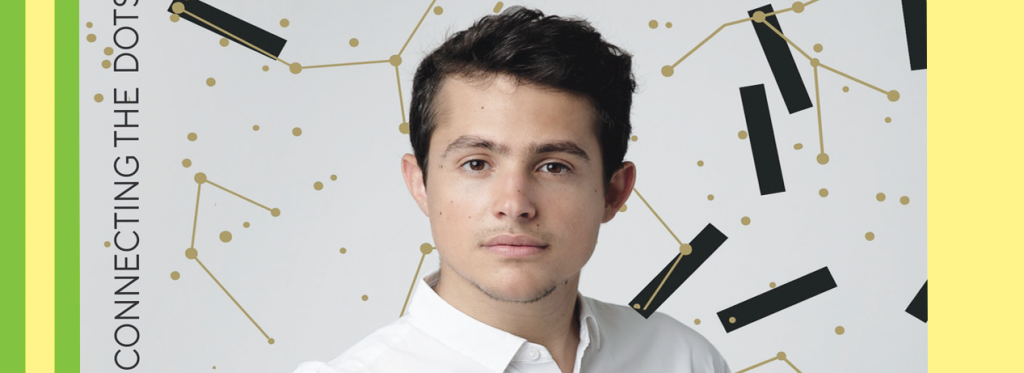
New Kid on The Block: Guy Mintus (MGBH) – Connecting The Dots

Young, enthusiastic, and talented, he has travelled the world with his performances sharing the sounds of love with his audiences.  Inspired by legends of jazz, Guy Mintus is not limited to jazz alone, but uses his cultural background to fuse world music into original compositions.

Piano Performer Magazine: At what age did you begin playing piano and why were you drawn to this instrument?
Guy Mintus (GM): My close encounter with music happened around the age of nine. It all started from a melody I heard on the radio – a song that really captured me, and I wanted to know how to play it. My grandmother had a piano at her home, and my grandparents from my mom’s side had a keyboard, but I never took an interest to them until that song came along. My mom helped me find it. She’s not really a musician, but has somewhat of a musical ear, and we found the first phrase, which I played with one finger on any keyboard that stumbled my way until my parents thought maybe they should teach me how to play the next phrase. Eventually that led to me taking keyboard lessons. When I started, they didn’t send me to take classical lessons, I just began playing Beatles songs, famous movie themes and Israeli pop until I got my first piano at the age of 13 and started to get more serious about music.

PPM: You play and compose in many different styles, can you tell us about some of your influences?
GM: I do compose is many different formats – whether it’s for my trio where it shifts from specificity to lots of freedom, western classical musicians where every note is written or for traditional musicians where it’s often just a melody. However, I don’t see it so much as different styles just different languages to convey what I have to say.  It’s all part of one thing, different inflections of my voice as an artist and as a person. I don’t really see the borders between the various styles.  I do realize they are necessary since we have to talk about music in some way, but essentially, when we look more closely, they don’t really exist.
Some pianists who influenced me are Thelonious Monk (OBM)), Art Tatum (OBM), Bud Powell, Horace Silver and Brad Mehldau.  I love too many kinds, as long as the music touches me, it doesn’t really matter to me where it came from or what style is it in.

I’m very much into Bach (OBM) as well, currently digging hard on the Goldberg Variations. When I was 19, I started getting into non-western music, which started with the Classical Ottoman (Old Turkey) music, and it continued with explorations and travels to study Flamenco, North African, Arabic and Greek music. When I moved to New York, I started getting exposed to a lot of Indian music and got to collaborate with quite a few musicians trained in different forms of Indian Classical music.


PPM: Can you tell us a little bit about your cultural background?
GM: I grew up in Israel in a suburb of Tel Aviv. My parents are both Israeli and born in Israel, but their parents emigrated from other countries. Both of my grandmothers are from Iraq, one of my grandfathers is from Casablanca, Morocco and the other one was from a small village in Poland. He arrived to Israel by escaping through Russia. I didn’t get to know him as he passed away when I was three.


PPM: What part did music play in your upbringing?
GM: I grew up with many different kinds of music around – Oriental pop, Beatles, bunch of rock bands, and some classical music. I also think the Middle Eastern heritage of my grandparents seeped in.

I was introduced to Jazz around the age of 13 through Thelonious Monk (OBM), when I first heard his version of Round Midnight. Until then I only knew it from music sheets – a simplified arrangement for beginner piano players. That was the only thing I knew about the song and about jazz.  One day I was in a record store with my father, I saw that there’s a Jazz section and decided to buy any record I could find that had that song on it – simply because that’s the only thing I knew. I ended up with a pile of records: Miles Davis (OBM), Dexter Gordon (OBM), Dizzy Gillespie (OBM) and Thelonious himself, solo album. Monk’s version was so free and radically different from everything, I thought the song was that I would say hearing that recording kind of changed my life. It opened me to the possibility of improvising, adding my own tones, digging deeper and deeper into the music – a process that continues until today.

PPM: What was a particularly memorable performance of yours?
GM: It’s hard to pinpoint, but one that strongly comes to mind is a performance that I did last May in a German town called Landsberg with the Bavarian Philharmonic Orchestra. I played Rhapsody in Blue by George Gershwin. As the soloist, I created my own version where I injected a lot of improvisation and kind of riffed off of some of the themes.

One of the special things about that concert was that it was in memory of a concert that Leonard Bernstein (OBM) gave in Landsberg in 1948 right after WW2.  It took place at a camp for displaced persons (survivors of the war – ex-concentration camp prisoners) who were staying there and decided to start and orchestra as a way to pass their time and lift up their spirits. When young Bernstein was touring in Europe for the first time, he heard about this orchestra and decided he had to do something with them. So, he took time from his tour to come to Landsberg to conduct and play Rhapsody in Blue with them. I did not conduct the group, but playing in the concert was amazing.  Descendants of members of the original orchestra from all over the world attended (Canada, US, Israel, New Zealand, all of Europe) as well as Bernstein’s nephew.  It was very, very powerful.

PPM: You recently released a new album, please tell us about it.
GM: It’s the second one with my trio, Philippe Lemm (MGBH) on Drums and Dan Papalardo (MGBH) on Bass – it is called “Connecting the Dots,” and we released it under the French Label Jazz Family.

The music on it comes from different sources and inspirations – from Horace Silver (OBM) to Zohar Argov (OBM), Barbara Streisand (MGBH) and Fairouz (MGBH), a neighborhood in NY’s Soho and the silk road. Musical and non-musical inspirations that has been part of my life and ended up being part of the album. It was never my goal to connect style X with style Y, but it’s just part of who I am, and so it naturally came out that way. Although there are all these influences, we put them all through our filter, the sound of the trio, the way we play, so it’s one sound connecting all the tracks and the thread is us. The album has two special guests – a legendary saxophonist David Liebman (MGBH) (Miles Davis (OBM, Elvin Jones (OBM) who plays on “Alvina Malkeno,” a traditional Jewish prayer from Yom Kippur – from the high holidays. It’s usually sung by a very powerful voice like a cantor or even Barbara Streisand has a version of it, but we thought what would it sound like have a very powerful voice but from another angle, an instrumentalist. Sivan Arbel (MGBH) is the second guest; she sings a song by Rumi (MGBH) – a Persian poet that I composed a song for. I sing as well on the on the last song – the Zohar Argov song. It’s a lot of fun.

PPM: Your performances have taken you around the world. What are some places and venues you hope to play at?
GM: I’ve been fortunate to travel a lot, although there are still many places I haven’t been to and many places that I’d like to return to, like India. I think about India a lot. Since I speak Spanish and feel like the culture and spirit of Latin America share many similarities with Israel and the Middle East, hot temperament, in particular, I really want to explore Central and South America at some point…

PPM: Does your approach to performing vary between the different genres of music you play?
GM: Yes and no.  I see it like walking into different rooms. In each room people might be speaking different languages and abide by certain unspoken rules. Each room has its own game. When I enter a room and wish to communicate in it, of course, I will have to adjust and speak the language, but it is still going to be me, my voice, my gestures, my inflections, body language, accent, etc.  Even if I try to, I can’t become someone else, so I accept being different, embrace it and actually enjoy it. Be authentic while having a conversation with the environment I am in. Being so much between worlds and formats, it is often my work to carve myself a space to be myself within different situations. Influence the room in way that we can have that conversation. With my Concerto for Orchestra & Improvising Pianist, I had to create those pockets in the piece where I can really play inside, outside or around the orchestra.  It was a challenge both writing and performing this composition, but it ended up going really well and was super satisfying for both the orchestra and me. The fact that we could all fully be ourselves in one room and have this exchange created a powerful feeling.

PPM: Who are some of the artists with whom you hope to collaborate with in the future?

GM: I recently experienced a performance from Laurie Anderson (MGBH) in Hamburg and was astonished. It was the first time that I saw one of her projects live. She’s such a mind-bending and mind-blowing artist, and I think it would be amazing to have the opportunity to work and share a stage with her. There are many other artists, but she’s the first one that comes to mind.

We are all mirrors of each other, and we effect each other’s vibrations. I think the main thing when working with different artists is developing flexibility and the ability to really listen to what someone else is doing at a given moment.


PPM: What lessons have you learned through working with many different artists?

GM: Every artists or every person that you get to spend time or work with, you learn something from. We are all mirrors of each other, and we effect each other’s vibrations. I think the main thing when working with different artists is developing flexibility and the ability to really listen to what someone else is doing at a given moment. It is important to understand quickly what your collaborator is doing or going for and immediately responding without being caught in preconceived ideas of what you’re supposed to do with them or what style or world they are coming from. It’s important to do your homework, but when you’re in the moment with someone in a room or on a stage, it’s just about listening and being present.

When you’re in the moment with someone in a room or on a stage, it’s just about listening and being present.


PPM: You have spent a lot of time in New York City, how has the city influenced you musically?
GM: I did spend a lot of time in New York, and it’s a home for me.  It’s one of my favorite cities in the world. I was lucky enough to be mentored by Jonny O’Neal, an African American jazz pianist from Detroit who played with the Jazz Messengers, Clark Terry and many other legends. He was also chosen to play Art Tatum by Oscar Peterson in the movie “Ray”. He’s an authority to an era of jazz piano that almost doesn’t really exist anymore. He’s a direct link to the source and is also an amazing vocalist and entertainer. I would go twice a week to see him perform with his trio and watch how he interacted with his audience and how he leads the band, how he transitions between songs or chooses his voicing. He is always very generous about sharing the stage with younger musicians.  Every time we would go to see him, he would either invite me to play with him or sit in with the group while he took a break, or have me accompany him in a duo while he would sing.  He would always incorporate me in some way. Working with him has been such a huge learning experience and a really big foundation for everything I do.  I don’t think I could get it anywhere else – there’s no other city where you could go and hear a giant like that two times a week. There’s so much going on in NY on any given night, and it just pushes you up. That city has such a cosmic quality, and it will always have a special place in my heart.

PPM: Have you ever taught piano?
GM: Yes, I’ve had the privilege to give many workshops around the world in in very different countries such as Spain, Switzerland, Brazil, India, Israel, and the US.  I’m very passionate about it and maybe learn even more than the students I’m teaching. I’m equally as excited to work with University Students of Jazz Studies as I am to work with kids. To me it’s the same thing – it’s about creating a spark of inspiration, and it can happen at any stage. I love doing that.  Getting people to improvise, connect with their creative instincts and to trust themselves. I don’t get to do it regularly, because of I’ve been touring a lot, but I know I will do more of it in the future.  It’s something I definitely like to come back to.

PPM: What are some of your future aspirations?
GM: Getting better at finding balance. I feel like that’s a big key. I’ve gone a long way with it, but there’s always more work to do. It’s an endless process to balance our lives and the various components in it.  In terms of music, I’m planning a solo album and would love to continue what I do while digging deeper and growing with that; working with orchestras, with my trio and doing more and more interesting collaborations.
The Venue: Palau De La Musica

Article by Alex Davydovich

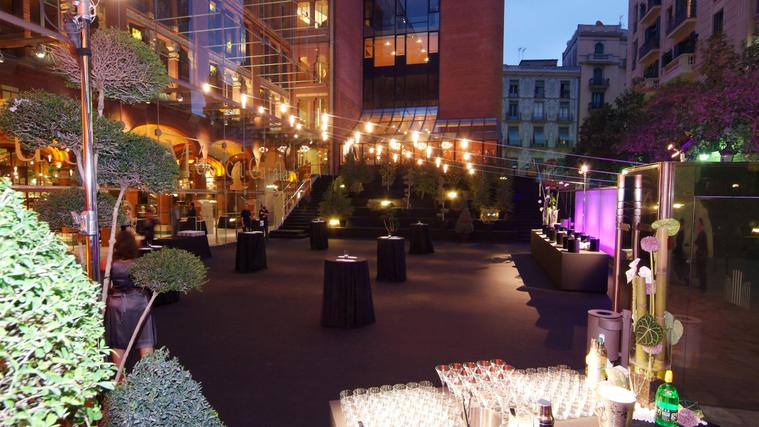
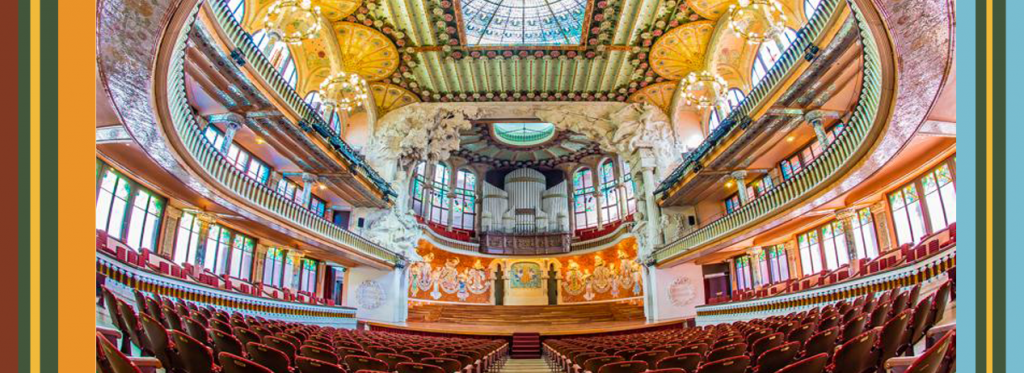
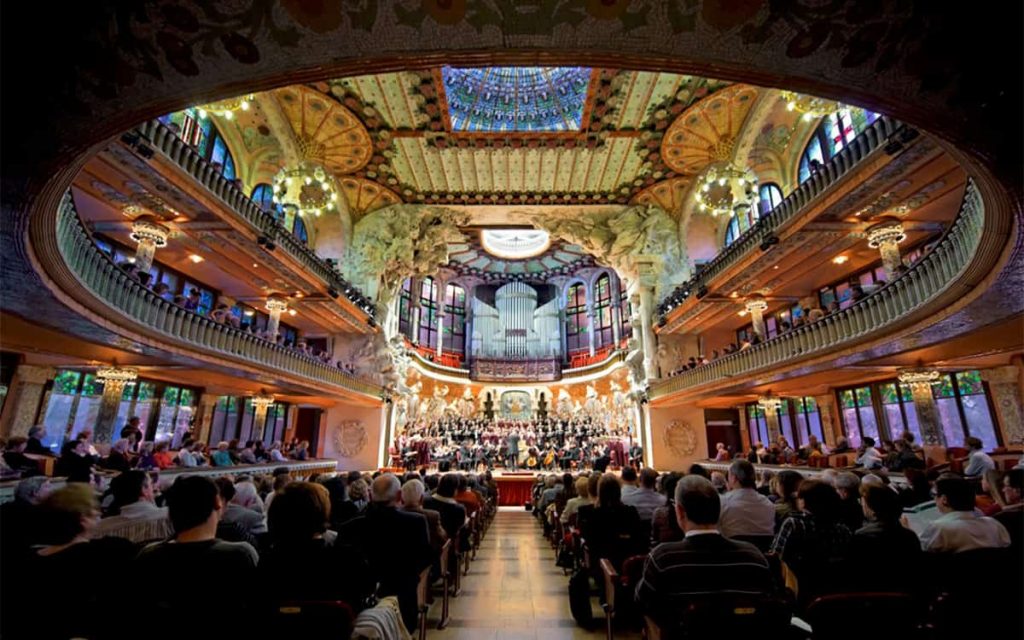
Located in Sant Pere district, Palau De La Musica is one of the most beautiful architectural landmarks of Barcelona, Spain. It was built between 1905 and 1908 by the modernist architect Lluís Domènech i Montaner (OBM).  The modernist building is designed around a central metal structure covered in glass, which exploits natural light to make the make Domènech i Montaner’s masterpiece into  a magical music box which brings together all the decorative arts: sculpture, mosaic, stained glass and ironwork.

The Concert Auditorium – one of the most distinctive in the world – is for more than hundred years the privileged setting for the musical life, both national and international, of the city of Barcelona. It has hosted world premieres and it is a landmark of symphonic and choral music. (1)

The Palau offers more than a 100 season concerts throughout the year. Such pianists as Valentina Lisitsa (MGBH), Benjamin Grosvenor (MGBH), Philip Glass (MGBH), Anton Bagatov (MGBH), Maki Namekawa (MGBH), Nelson Goerner (MGBH), Joaquín Achúcarro (MGBH), Seong-Jin Cho (MGBH), Daniel Ligorio (MGBH), Juan Perez Floristan (MGBH), Martina Filjak (MGBH), Evgeny Konnov (MGBH), and others are to be greeted by the audience during this season.

Petit Palau

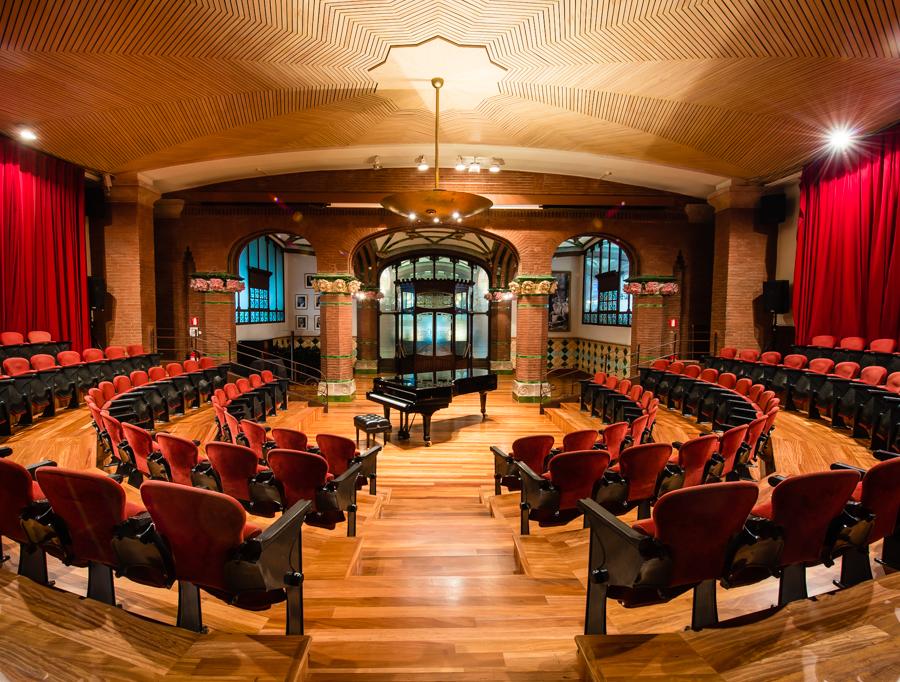
Along with its main concert hall, Palau has two other venues for the artistic life of the institution. One is the Petit Palau, a modern auditorium that opened in 2004. Ideal for chamber music or small-format concerts and offers excellent acoustics and high-tech audio-visual equipment. (2)

Sala d’Assig de l’Orfeo, or The Rehearsal Room

Another little jem of the Palau de la Música is the Sala d’Assaig de l’Orfeó Català, the Orfeó Català Rehearsal Room. A cosy, intimate venue for small-format concerts, talks, and presentations. The first stone of the Palau, laid in 1905, is here. (3)

Sala Luis Millet, or Lluis Millet Hall

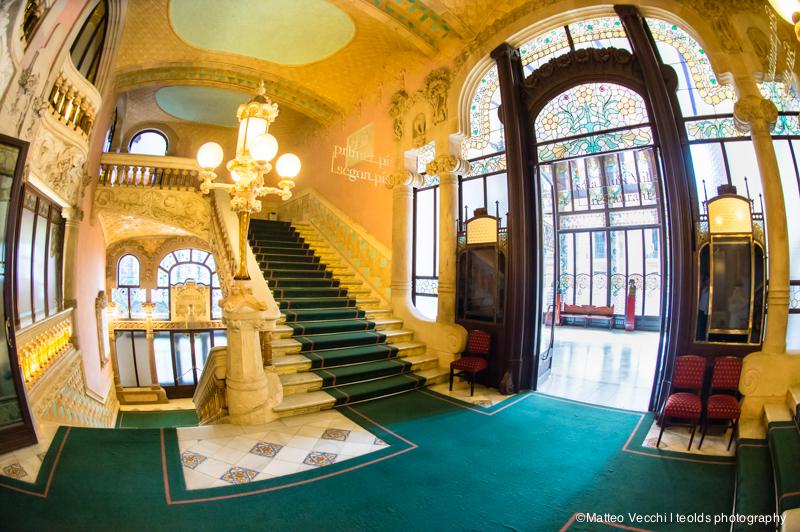
The great Sala Lluís Millet, or Lluís Millet Hall, a meeting place in intermissions dedicated to Maestro Millet, the founder of the Orfeó Català. The hall is two stories high, with great stained glass windows decorated with floral designs, giving an extraordinary effect. Even more exceptional is the balcony which can be seen through these windows, with its double colonnade decorated with distinctive colors and ornamentation. (4)

Mirador Restaurant

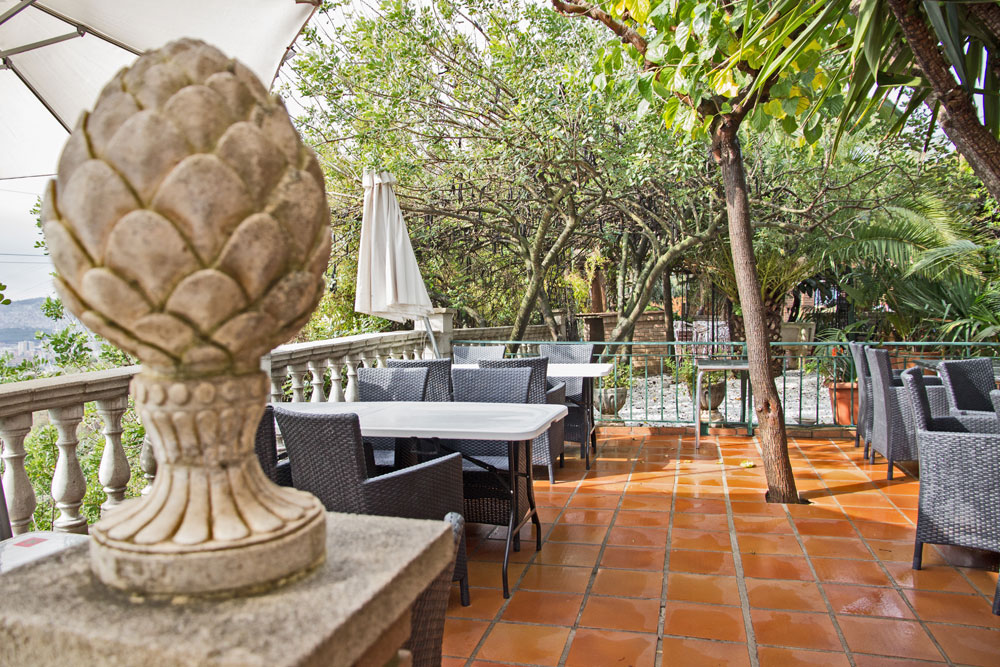
The Mirador Restaurant, located at the top of the Plaza del Palau and overlooking the front, offers a superb view of the Art Nouveau façade by Domènech i Montaner. (6)

The restaurant offers only service on request for groups.

Many companies and individuals choose the Palace of Catalan Music to celebrate all kinds of cultural, social and business events.

References:

(1) https://www.palaumusica.cat/en/the-concert-auditorium_550481

(2) https://www.palaumusica.cat/en/petit-palau_550514 

(3) https://www.palaumusica.cat/en/rehearsal-hall-of-the-orfeo-catala_550561

(4) https://www.palaumusica.cat/en/lluis-millet-hall_550575

Teacher To Teacher: Piano Games from Valerie Sabbah (MGBH)

Interview by Esther Basha

In this issue we are launching a new section “Teacher to Teacher,” where piano teachers around the world will be able to have an opportunity to share their insights and experiences with their colleagues.
In this interview, Valerie Sabbah, a Montessouri music and piano teacher from France, shares her story and presents the music games she has created for children.

Piano Performer Magazine: What town did you grow up and how did you get introduced to music?
Valerie Sabbah: I grew up in Bougival, a small town 10 km from Paris. There I started learning music between the ages of 8 and 12 in a local music school. As a teenager, I decided not to continue since learning to read music was very difficult for me at that time.  It wasn’t until my late teens when I finally came back to it and then completed the music studies program at the age of 20.  I had the opportunity to study with such renowned pianists and teachers as Janine Vieuxtemps (MGBH), Jean Fassina (MGBH), Christophe Brillaud (MGBH) (former student of Aldo Ciccolini (OBM)), and Yacov Aïvaz (MGBH) who was a pianist at the Moscow Philharmonic.

PPM: What made you want to become a music/piano teacher?
VS: Although I graduated from a music program, I didn’t feel a drive at that time to pursue it professionally.  I became interested in interior design, and while I was going to school for it, I used my music training to help me finance my studies.  The first student I had changed my life. He was autistic, but his father didn’t tell me about it.  Probably, so that I could teach him music in the most natural way possible.  I had to create a whole bunch of musical games in order to see what he understood and what he didn’t, and thus, to help him as much as possible.  That’s how I discovered my passion for children and teaching.

The first student I had changed my life. He was autistic, but his father didn’t tell me about it. Probably, so that I could teach him music in the most natural way possible.

PPM: What music teacher had the biggest influence on you and why?
VS: Jean Fassina (MGBH). He taught me to hear and work on hand movement awareness.  It was a very long and difficult job, but it changed the way I played.  It was through him that I discovered the parallel world of music – the one where we discover that the most important thing is not the note, but the sequence from one note to another and the sound quality.

PPM: Today you teach music at the Montessori school in France. What is the Montessori approach to music education? What ages do you teach?
VS: Montessori is a gentle approach to learning, without any force.  It is not the child who adapts to the method, but rather the teacher who adapts the method to the child. This is why manipulation of objects is very important in this approach, because it allows the child to understand through his or her own experience/experimentation vs through learning only in an intellectual way.
In my current school, I teach about a hundred children (5 classes) 3 to 10 year-olds.
This quote by Benjamin Franklin (OBM), which I use regularly, sums up the Montessori philosophy well, “You tell me, I forget. You teach me, I remember. You involve me, I learn.”

PPM: Please, tell our readers about your music games and what inspired you to create them.
VS:  I was committed to adapting to the needs of the students.
Personally, I wasn’t a very good student at the music school, and I would often hear sentences like “you’re not cut out for music”… My heart, however, told me the opposite: when I watched a movie, it was mostly because I liked the music, and I could wait until the end to hear 3 magical notes.
So, I persevered in music while continuing other studies, just in case, then I met the right people.

What inspired me to create musical games is the same reason that led me to become a music teacher. I was committed to adapting to the needs of the students.

Today, I also compose music.  Two of my songs are played in music schools in France – including the conservatory where I studied – and my games are used in most music schools in France.
Currently one of the songs is being recorded by Giovanni Mirabassi (MGBH), Karol Dobrowolski (MGBH) and Greg Zlap (MGBH).

I am committed to making music theory easy and accessible to everyone.   I would like to give teachers and students educational tools that will allow them to have more fun learning something that is often perceived as complicated when it is not.

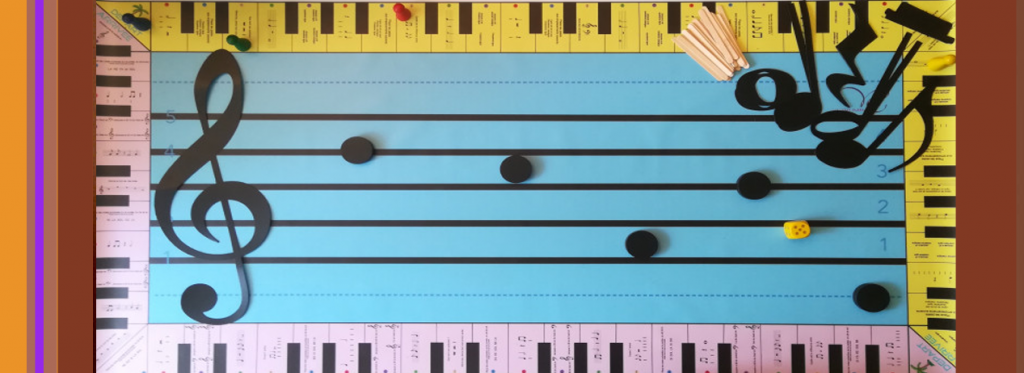
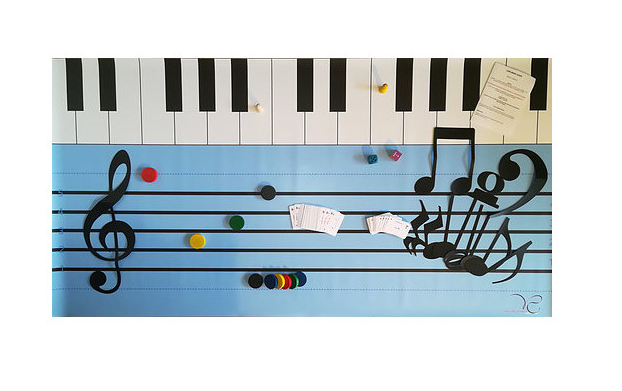
First, I created the Music Story game – a solfege mat – one or two staffed – depending on the instrument one plays. The counters represent the musical notes and the sticks are the pulsations.

First, I created the Music Story game – a solfege mat – one or two staffed – depending on the instrument one plays. The counters represent the musical notes and the sticks are the pulsations. There are also basic musical symbols.  The teacher offers games of notes, rhythms, dictations, singing etc., and the child can discover music theory through a game.  The student does not realize that he is learning something that is normally learned from books.
This game has several versions. A version for parents/families, which is Social Music Story, whose objective is to have crossed the keyboard first. All other versions are intended for teachers or parents who wish to provide their music teacher with a medium to teach music theory.

Thanks to this game, you can learn music theory and play music from the age of 3. Starting with a music story, a few months are enough at that age to master the process of reading notes and rhythmic bases.

In my online shop, you can also find games to discover musical instruments or have fun with sounds, such as the Bingo Game, the International Cone Game, the Instrument Wheels, the Toddler Sound Level Meter, the Sound Mill  as well as card games to work on your notes or rhythms.

PPM: Please, tell us about your Music Wheel Game. It sounds interesting.
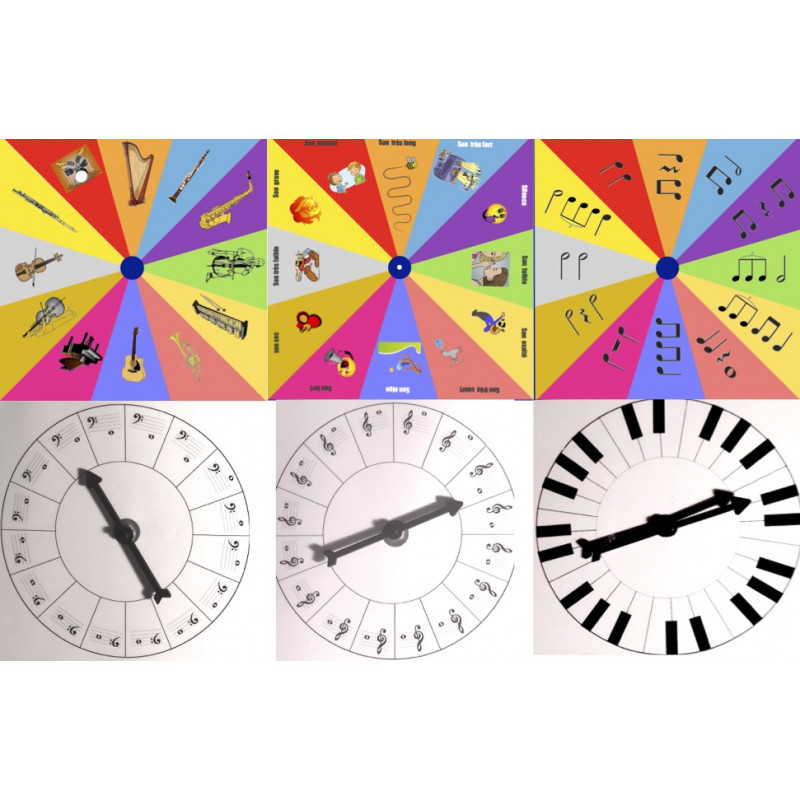
VS: In music lessons, I use the wheels according to the age and level of the children. With the smaller ones I will use the Musical Instrument Wheel, the Sound Level Meter or the Wheel with the Keyboard. With the older ones, we will use the Note Wheels or the Rhythm Wheel instead.

They are all used in the same way, you turn the arrow and you have to imitate the sound, name the instrument (and imitate it), sing the rhythm or say the note on which the arrow has stopped.  Personally, I regularly use the instrument wheel, the sound level meter, and the wheel with the keyboard during musical awakening sessions with toddlers, and in groups of about 12 children, the children turn the wheel one after the other, and usually impatiently await their turn. Concerning the other wheels, I use them either in class with the older ones or in private music lessons.

PPM: What advice can you share with young music teachers who are just starting up?
VS: We must strive to find the right balance between play and discipline. The game must serve the learning process, but the course must under no circumstances be transformed into a playground. However, the adult must enter the child’s world for the child to want to listen and, therefore, learn. For me, a good teacher is a grown up who can connect to his child within. You can relate a message and teach anything by making it fun!

PPM: Where and how can other music teachers order your games to incorporate them in their teaching practice with their students?
VS: For the moment, the US based teachers can purchase the games on my website: https://www.valeriesabbah.com/gb There is a discount code the the Piano Performer Magazine readers – enter “PianoPM-10” to get 10% off excluding shipping.  Allow 10 to 15 days for delivery. If a customer needs additional information about a product before committing, he can contact me by email at clesdelamusique(@)gmail.com, or via Whatsapp.

PPM: Thank you, Valerie. We hope your creativity and desire to share and spread the love will be appreciated by your US colleagues.

A Tribute to Masters:
Philippe Entremont (MGBH) – 70 Years In Black and White.

Interview by Esther Basha

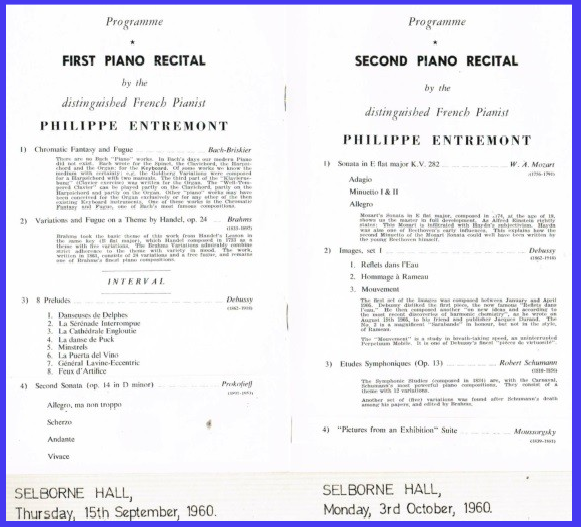
This year we are celebrating the 85th anniversary of a world renowned pianist Philippe Entremont.  His career and life has been long and rewarding, and today he continues to thrive through his connection to music and his Italian friend Pianoforte.  In this interview we tried to ask him questions that would help our readers see him not only as a professional, but also as a man of many admirable qualities.  We hope you enjoy this interview and get a personal insight into some professional secrets of the Piano Master.

Piano Performer Magazine: Do you come from a musical family? What was your first childhood encounter with the piano?
Philippe Entremont (PE): Yes, I do come from a musical family.  My father was a violinist and a conductor, and my mother – a pianist and a piano teacher. My first instrument was the violin. And I wasn’t really in love with the sound I produced with the violin at the beginning… at all! At home the piano was in the room where I studied the violin. To me it was a nice instrument, a beautiful piano, and I really didn’t understand why I should be standing instead of being comfortably seated at the piano….I was extremely lazy as a kid. So I said, “I think I better play the piano because at least I can sit down.” And I put the hand on the piano, and it worked like magic. That was the end of my violin career and the beginning of the encounter with my now good friend – the piano.

I was extremely lazy as a kid. So I said, “I think I better play the piano because at least I can sit down.” And I put the hand on the piano, and it worked like magic.

PPM: When was your first public piano performance? What did you feel before and after?
PE: I gave my first public performance when I was 10 years old. I played the piano part of the 1st Mozart Quartet with my father’s ensemble. The concert took place in Reims, my home town. I have beautiful memories of that concert. Although it was my first performance, it went very smoothly.  In confidence, I was told that General Eisenhower (OBM) was in the audience! Do you know that the end of the 2d World War was signed in Reims in the school my father was teaching at and, in fact, at his office table!?

PPM: Which teacher influenced you the most?
PE: When my passion towards piano became evident to my parents, they decided to teach me professionally.  I had a chance to have a fabulous teacher – Rose Aye-Lejour (OBM) – who was the main assistant of Jean Doyen (OBM), my principal teacher at the Conservatoire de Paris (where I studied from the age of 12 to the age of 15).

PPM: How much time do you devote to practice?
PE: I don’t think it’s the number of hours that I spend with the instrument. I am blessed with the fact that I don’t really need any warm up to play. That’s a big plus. If you play with the right concentration, you don’t need so many hours.  In my case, I play about two hours a day, but I think a lot.

PPM: Who are some of your favorite pianists?
PE:I admire immensely such pianists as Serguei Rachmaninov (OBM), Rudolf Serkin (OBM), Emil Guillels (OBM), Wilhelm Backhaus (OBM), Arthur Rubinstein (OBM), Alicia de la Rocha (OBM) to name a few.

PPM: Please, tell our readers about your most recent recordings.
PE: Last year I recorded the Schubert D960 Sonata. That piece was on my list for decades…. This year I recorded 4 Beethoven sonatas, and each one represents the diversity of his genius. For my 85th birthday Sony is issuing a 35CDs box set “Philippe Entremont: the Complete Piano Solo Recordings on Columbia Masterworks.”

35CDs box set “Philippe Entremont: the Complete Piano Solo Recordings on Columbia Masterworks.”

For my 85th birthday Sony is issuing a 35CDs box set “Philippe Entremont: the Complete Piano Solo Recordings on Columbia Masterworks.”

PPM:  Throughout your career you have played over 7, 000 concerts. How did you manage to play that many?
PE: One thing I noticed, in spite of the huge number given annually, I never encountered any special fatigue and although it’s  hard to believe, I still feel the same way even now at my age. I know how to breathe with music, I never go too far with effort. An on stage, I really feel at home.

PPM: You played with the most famous orchestras under the baton of the most  renowned conductors. What memories stand out for you?
PE: When I was under 20,  a lot of people especially in France, were amazed and fast to say how lucky I was to be invited to play at the Carnegie Hall. Perhaps, I was lucky to get in, but after I was invited again and again… not only as a pianist, but also as a conductor.

I will never forget a Carnegie Hall concert presentation with the Alban Berg Quartett playing the Schumann (OBM) Piano Quintett. This performance was luckily recorded, and this recording is still available on the EMI label.

I played at Carnegie Hall with an incredible number of orchestras – the New York Philharmonic, the NDR orchestra from Hamburg, the Orchestra of the Americas conducted by Leopold Stokowski (OBM), the Wiener Symphoniker,  the Vienna Chamber Orchestra under my conducting (many times), the Dresden Philharmonic also under my  conducting, the New Orleans Philharmonic Orchestra and many more….

We must not forget that I gave an equivalent number of concerts at the Avery Fisher Hall of the New York Philharmonic Orchestra.

PPM: Do you ever experience stage freight?
PE: I do have fears like everybody else – I am subject to stage fright. That’s no doubt. Before a concert I am a wreck. And I have decided a long time ago that stage freight is my friend. If I don’t feel that, I know that something wrong. I need it… I need to be totally distraught before I am on stage, and as soon as it starts, it clears up… Just like the cold. I am miserable before the concert.

Before a concert I am a wreck. And I have decided a long time ago that stage freight is my friend. If I don’t feel that, I know that something wrong.

PPM: Do you think about the audience when you are on stage?
PE: The communication between the audience and the artist is tremendous. And I feel.. I am very sensitive to the quality of the audience. I can hear people listening.

PPM: Having had such a busy career, have you had time to build a family of your own?
PE: Yes, I have been married for 64 years. My wife Andree (MGBH) and I have two children – a daughter Felicia (MGBH) and a son, Alexandre (MGBH), who is a prominent physician.

PPM: Do you have any pets?
PE: Yes, a cat named Sam.  I always had cats.

PPM: What is your favorite part of Paris?
PE: Place Vendôme, not far from where I live.

PPM: You have been invited as a judge to many piano competitions. What criteria do you usually use in making your decisions of who deserves the award?
PE: It’s not easy, because there are so many things involved. The performance has to please me, of course, but I am only one person. I understand very well that maybe someone else does not like the performance as much as I do. When I am in a jury and there are so many pianists – one after another – I am always interested in the one who is waking me up. It’s as simple as that. The one that puts me on the edge of the seat. I like artists who are not afraid of taking chances.. And it is wonderful to have the courage and the vision. I try to be extremely honest. I place music first. I look for comprehension of the piece. I am extremely sensitive to the sound. And I love people who are not afraid to use nuanced play.   It’s so important to use the pedal well.  Especially with the piano that we are using today. We have to be extremely discrete with the pedal. You have to practice it the way you practice the hand.

I like artists who are not afraid of taking chances..

PPM: What about the technique?
PE: If you don’t have a good technique, you don’t have the tools to project the quality of your interpretation.

PPM:  What was is like for you to participate in a competition early on in your career?
PE: I was very young – 17 at the time. It was the beginning of my piano career. And there were great people at the jury at the time – Emile Gillels (OBM) and Arthur Rubinstein (OBM). Not bad. And speaking of Rubenstein, this is the pianist that I admire immensely. And… I miss him. We knew one another extremely well. Much more than people think. And I remember talking to him when I was very young trying to ask him very timidly if I could work with him. And he said to me, “Never.” It shocked me. And I said, “Why?” He said, “I know it’s going to be alright. You are going to make a mistake, but I have total confidence in you. ” Isn’t it wonderful? And I will never forget that. That was an excellent way to putting things. But when you have mastered your craft and you reach a very high level, your best teacher is yourself. And this is a fabulous responsibility.

When you have mastered your craft and you reach a very high level, your best teacher is yourself. And this is a fabulous responsibility.

PPM: Thank you for the interview and congratulation on your anniversary!