Piano Performer Magazine
FEATURED INTERVIEW:
VLADIMIR ASHKENAZY (MGBH) – WAY BACK WHEN
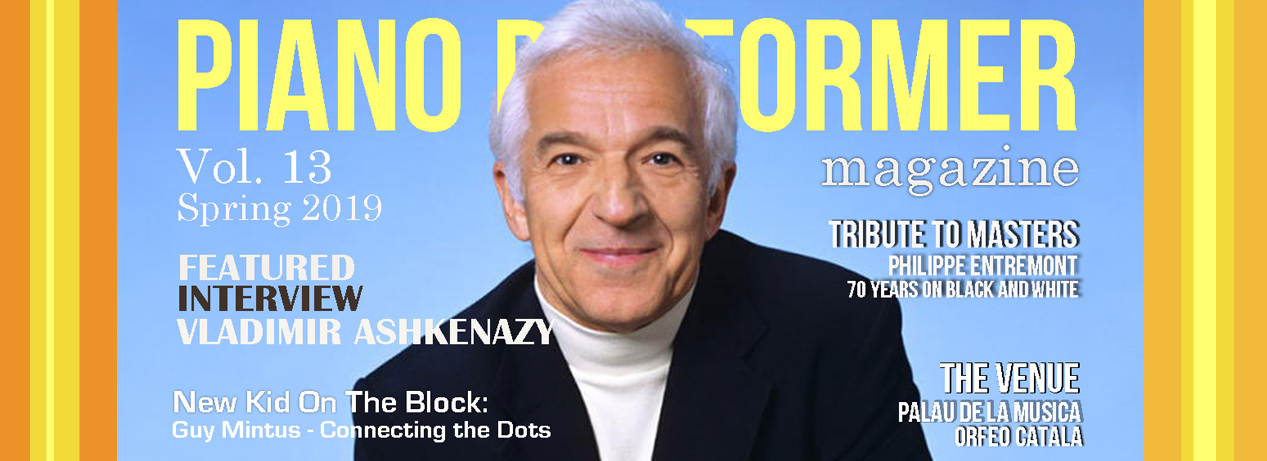
Sometimes they say that new is nothing but well-forgotten old. And it is exactly the case with the material of this interview. Conducted by Roy Plomley (OBM) at BBC in 1978 – over forty years ago – this piece transports us back in time and gives us an opportunity to see the Vladimir Ashkenazy way back when while knowing who he had become today.
Interviewer: You were born in Russia in the town of Gorky. That wasn’t the original name of the town, was it?
Vladimir Ashkenazi: No. The original name was Nizhnii Novgorod.
I: And it was renamed after the writer.
VA: Correct.
I: You moved to Moscow when you were very little.
VA: Yes, when I was three, I think.
I: ….and there was a lot of music in your home?
VA: My father is a pianist and there was some music in our home. Not very much and it wasn’t classical it was popular.
I: And your mother? Is she musical?
VA: No. My mother is not, but she was the one who noticed that I was rather interested in music. We didn’t have an instrument. Only when I was six. I remember my mother asked me whether I would like to start studying playing an instrument. And I said yes, and she asked me what instrument. I said piano, because my father was a pianist. So, that’s how it started.
I remember my mother asked me whether I would like to start studying playing an instrument. And I said yes, and she asked me what instrument. I said piano, because my father was a pianist. So, that’s how it started.
I: Music teaching in Russia is rather more intensive than in other countries.
VA: Yes, the system is such that gifted
children are easily channeled to good music schools. It’s a very good system in that respect.
I: You went on to the the Moscow Conservatory.
VA: That’s right.
I: You began taking part in a lot of competitions. Was this a standard part of the Russian musical education? At 18, you won the Second prize in the Chopin competition.
VA: It’s not a standard part of the education. It’s the most desirable path for a young musician to be a winner of an international competition. And the system is somehow geared to that – that unless you win a competition you have no chance of being on a concert platform. And I was simply a cog in the wheels, you know. And I went to those competitions because I was sent to them.
I was simply a cog in the wheels, you know. And I went to those competitions because I was sent to them.
I: There’s one that you won in Belgium. A competition, which sounds terribly grueling – Queen Elizabeth Prize.
VA: Yes, it is a very difficult one. The range of repertoire is enormous, and you have to learn a new piece in The Final Round. A new unknown piece written especially for the competition in eight days and played with the orchestra. So, that’s difficult.
I: Are you a quick study? Can you memorize easily?
VA: Yes I’m rather quick. Fortunately that’s a gift from nature.
I: You had some very distinguished judges in that competition.
VA: Yes, we had Rubinstein (OBM), Casadesus (OBM) and Gillels (OBM).
I: And that earned you a tour of the United States.
VA: Um, I suppose so. Yes, I suppose that was the most important element.
I:Of course, you still haven’t graduated you had to go back to the Conservatoire. I think it was in your final year that you met an Icelandic student.
VA: No, we met in 1958 when she came to participate in the first Tchaikovsky Competition, in which I did not participate. Then she came back in 1960 to study in the Conservatory with the same piano teacher as I was studying – Mr. Lev Uborin (OBM), and that’s when we met a lot. And we got married in 1961. And I graduated from the conservatory actually at the end of 1960.
I: Now your career was getting worked very well underway. You were a married man, and you took part yourself in the Second International Chaikovsky competition.
VA: That’s right.
I: And you won it.
VA:Yes, it was against my will I never wanted to participate. The authorities simply told me of couple of times on a very high level that unless you participate you might as well forget about your career.
I: The Russians wanted a Russian to win it. Was that the idea?
VA: They needed a very strong team and they needed a leader. So, they were trying to gather the strongest they had at that moment, and I belonged to that category at that moment. And I married a foreigner, which is already an anathema in Russia, you see. And they banked on it. They said, well, you know what’s happening with you. And if you don’t participate, you can count your international career finished. So, what can you do?
I: Right. Well you entered, and you won. In fact, you tied for the first prize with an Englishman John Ogden (MGBH).
VA: Yes. Well, for practical purposes, there’s no difference whether I tied or not. The most important part was that I was also a winner. And for practical reasons it was enough. Having won the first prize I was in the position to count on international tours although I was married to a foreigner. You see, there are degrees in life in Russia where you know that this helps you and this doesn’t. And if even if you have some negative circumstances you know, which kind of a positive circumstance might tip the balance in your favor. And that was it, you see.
Having won the first prize I was in the position to count on international tours although I was married to a foreigner.
I: So, it did lead to a lot more overseas engagements. Now, there was a complication. Your wife Thorunn (MGBH) didn’t enjoy living in Russia.
VA: No. It’s not surprising. It’s difficult to adapt yourself to those circumstances.
I: Icelandic, he had been brought up in England.
VA: Yes, that’s true. Basically in England she’s very much Icelandic, of course. Well, it was hard to to to live in Russia. It’s hard for Russians to live in Russian. It’s infinitely harder for foreigners to try to live there. But the problems aren’t just the lack of the usual freedoms which would take for granted in the West. It’s not only that, but the problem with her was also that many Russians became suspicious that she wanted to actually live in Russia. They don’t expect that foreigners would like to live in Russia and would like to openly try to adapt themselves. It’s very strange and there isn’t enough time really to explain it. But when she, in fact, took up Soviet citizenship, which was also actually imposed on us, the people in the conservatory suddenly became unfriendly. Because when she was a visitor a foreigner, it was one thing. But when a foreigner tries to be one of those, that’s a different thing – they wouldn’t like to mix with her. And that upset her very much. She didn’t expect that.
I: So, you decided to live in the West. This of course wasn’t a political decision at all. It was simply an emotional one.
VA: Yes, initially it was very very much emotional. But I was aware that any decision of this kind will have great political repercussions, because anything concerning the West with Russia has political undertones and overtones, and everything is politically colored. And, of course, I was right. It was taken very much politically in Russia.
I: How much of the year do we spend traveling?
VA: I think, seven or eight months.
I: It’s a long time to be away from home. You moved now your base to Reykjavik, to Iceland. That must be rather badly positioned for world travel.
VA: Yes, it isn’t. It isn’t so well positioned and, in fact, we have now divided our time between Iceland and Switzerland. Switzerland is so centrally located. So, we’re sort of in-between.
I: You’ve done a great deal for musical life in Iceland.
VA: Oh, I would like to evaluate what I’ve been trying to do in Iceland. I simply participated in the music of Iceland as much as I could. I tried to organize a festival, bring some fairly well-known and wonderful artists, most of whom actually are friends of mine, so it was rather easy for me to get them there. I played a few times and conducted the local orchestra. But I don’t attach too much value to what I’ve done. It’s only natural.
I: You believe in the casual approach. I saw you playing a major concerto the other evening at the Festival Hall with 40 members of the London Symphony Orchestra sitting around in white tie and tails. You had a dinner jacket and a sweater.
VA: It’s not exactly a sweater. Oh, you call it a sweater… It’s a white polo neck. Okay, fine, okay. I think one should play in something very simple, and ordinary, and comfortable. And what I wear I think is quite ordinary, quite simple, and it’s comfortable at the same time. I think tails should sort of go away soon. I think it’s almost like a masquerade. It doesn’t relate to music at all, I think. Well, those things hanging behind you and the bow tie. Sometimes they look like waiters. I think there is no point in that. I think we should really drop it one day.
I: When did you make your very first record? Before you left Russia?
VA: Yes, I recorded in Russia after the Chopin Competition and again before and after the Tchaikovsky Competition.
I: Have you any idea how many records you’ve made all together? It’s a very large number, isn’t it.
VA: Yes, and I didn’t know whether I should be proud of it. Because not everything is good in my recordings. Yes, it is something like 60 discs or something. For a pianist, it’s quite a lot.
I: You’ve recorded all the Beethoven, Rachmaninoff, Prokofiev concertos. You have some very ambitious recording projects that you’re working on which are going to keep you busy for a long time. You’ll get to do all the Chopin pieces.
VA: Yes, and all the Beethoven sonatas and the Bartok Concertos. It’s a lot to do. Yes, I look forward to it.
I: And now, of course, conducting is quite a growing part in your career. You like conducting, don’t you?
VA: Yes, I enjoy it very very much.
I:There’s a new recording of yours of Tchaikovsky 5th symphony, which you’ve conducted, which is I believe going very very well indeed.
VA: That’s nice to hear. When I listen to it, I hear all the fault. It’s terrible. It’s a little easier with orchestral recordings, because although you conduct, you’re not really producing the sound yourself. And so when you enjoy certain passages in an orchestral recording, somebody else is doing that.
I:How many concerts do you play a year? Do you restrict yourself to a certain number?
VA: I don’t usually plan in terms of how many contests I should play. I plan in terms of what repertoire I want to play and how many times I want to play a certain piece before I either record it or play it in London or in New York in very important places. And this brings me usually to over 100 concerts a year.
I don’t usually plan in terms of how many contests I should play. I plan in terms of what repertoire I want to play and how many times I want to play a certain piece before I either record it or play it in London or in New York in very important places.
I: That’s a lot. What proportion of those are with an orchestra as a pianist?
VA: I think it’s really evenly divided. Roughly, I think it’s half the time.
I: How much does contemporary music interest you?
VA: As information about what’s happening in music, it interests me a lot. As material for performing – not so much, because I don’t find many inspired works written for the piano. The piano is very often an old fashioned producer of sound, so to speak, for the further modern composers. They need video for new sources of sound electronic. And if it’s the piano, then it has to be broken to pieces and interfered with, you know, the most natural way. So, there isn’t so much I don’t think for the piano anymore.
I: You don’t fancy Ashkenazi and his electric piano. Does your wife still play the piano?
VA: She can and she could, but she doesn’t.
I: She hasn’t pursued her career.
VA: No, she decided to drop it entirely when we got married. And I think she was very wise, otherwise it would have been a very difficult marriage. Two concert artists sort of tend not to meet too often.
I: Yes, you have three children.
VA: We, have no have for four. We’re expecting the fifth.
I: Is there any musical talent showing in the older ones?
VA: They’re all musical, and I think they have certain gifts in music. But it’s hard to say how big and large gifts are. They still studying a little bit.
I: You’ll be playing septets one day.
I: What would you take with you on a deserted island apart from the Bible and Shakespeare, which are already on the island? And we don’t allow multi volume encyclopedias.
VA: ;I must confess. Honestly, I could not think of any other books that I would like to have if I already have the Bible and Shakespeare. Well, maybe I should have just a blank book and I could, perhaps, write something in it. Just for myself, for my own consumption, you know. No so arrogant as to think it could be of any value to others.
I: Thank you, VLADIMIR ASHKENAZY.
VA: Oh it’s my pleasure. And I’m very grateful that you invited me. Thank you very much.