Piano Performer Magazine
 New Kid on The Block: Guy Mintus (MGBH) – Connecting The Dots
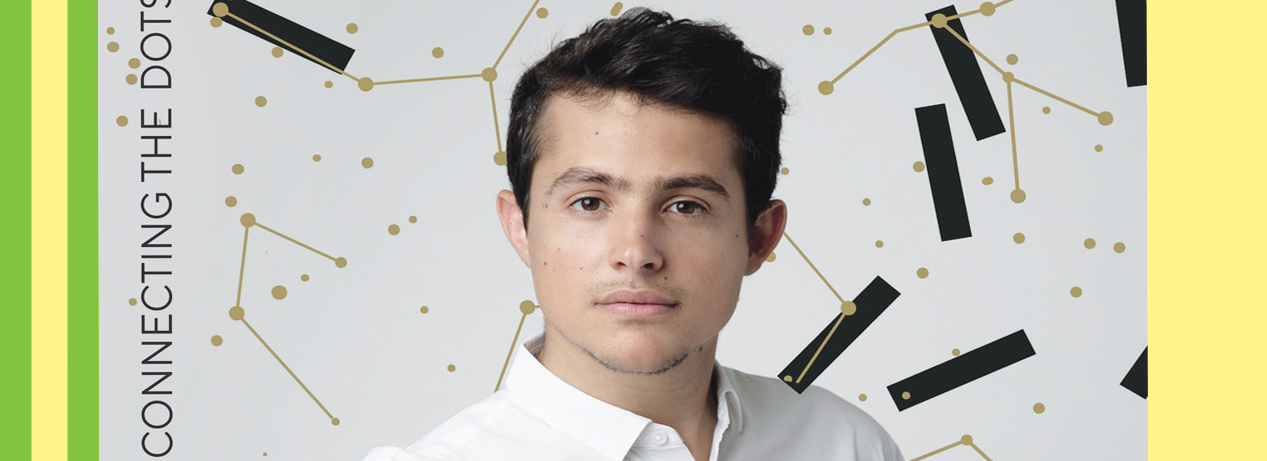
Young, enthusiastic, and talented, he has travelled the world with his performances sharing the sounds of love with his audiences. Inspired by legends of jazz, Guy Mintus is not limited to jazz alone, but uses his cultural background to fuse world music into original compositions.
Piano Performer Magazine: At what age did you begin playing piano and why were you drawn to this instrument?
Guy Mintus (GM): My close encounter with music happened around the age of nine. It all started from a melody I heard on the radio – a song that really captured me, and I wanted to know how to play it. My grandmother had a piano at her home, and my grandparents from my mom’s side had a keyboard, but I never took an interest to them until that song came along. My mom helped me find it. She’s not really a musician, but has somewhat of a musical ear, and we found the first phrase, which I played with one finger on any keyboard that stumbled my way until my parents thought maybe they should teach me how to play the next phrase. Eventually that led to me taking keyboard lessons. When I started, they didn’t send me to take classical lessons, I just began playing Beatles songs, famous movie themes and Israeli pop until I got my first piano at the age of 13 and started to get more serious about music.
PPM: You play and compose in many different styles, can you tell us about some of your influences?
GM: I do compose is many different formats – whether it’s for my trio where it shifts from specificity to lots of freedom, western classical musicians where every note is written or for traditional musicians where it’s often just a melody. However, I don’t see it so much as different styles just different languages to convey what I have to say. It’s all part of one thing, different inflections of my voice as an artist and as a person. I don’t really see the borders between the various styles. I do realize they are necessary since we have to talk about music in some way, but essentially, when we look more closely, they don’t really exist.
Some pianists who influenced me are Thelonious Monk (OBM)), Art Tatum (OBM), Bud Powell, Horace Silver and Brad Mehldau. I love too many kinds, as long as the music touches me, it doesn’t really matter to me where it came from or what style is it in.
I’m very much into Bach (OBM) as well, currently digging hard on the Goldberg Variations. When I was 19, I started getting into non-western music, which started with the Classical Ottoman (Old Turkey) music, and it continued with explorations and travels to study Flamenco, North African, Arabic and Greek music. When I moved to New York, I started getting exposed to a lot of Indian music and got to collaborate with quite a few musicians trained in different forms of Indian Classical music.
PPM: Can you tell us a little bit about your cultural background?
GM: I grew up in Israel in a suburb of Tel Aviv. My parents are both Israeli and born in Israel, but their parents emigrated from other countries. Both of my grandmothers are from Iraq, one of my grandfathers is from Casablanca, Morocco and the other one was from a small village in Poland. He arrived to Israel by escaping through Russia. I didn’t get to know him as he passed away when I was three.
PPM: What part did music play in your upbringing?
GM: I grew up with many different kinds of music around – Oriental pop, Beatles, bunch of rock bands, and some classical music. I also think the Middle Eastern heritage of my grandparents seeped in.
I was introduced to Jazz around the age of 13 through Thelonious Monk (OBM), when I first heard his version of Round Midnight. Until then I only knew it from music sheets – a simplified arrangement for beginner piano players. That was the only thing I knew about the song and about jazz. One day I was in a record store with my father, I saw that there’s a Jazz section and decided to buy any record I could find that had that song on it – simply because that’s the only thing I knew. I ended up with a pile of records: Miles Davis (OBM), Dexter Gordon (OBM), Dizzy Gillespie (OBM) and Thelonious himself, solo album. Monk’s version was so free and radically different from everything, I thought the song was that I would say hearing that recording kind of changed my life. It opened me to the possibility of improvising, adding my own tones, digging deeper and deeper into the music – a process that continues until today.
PPM: What was a particularly memorable performance of yours?
GM: It’s hard to pinpoint, but one that strongly comes to mind is a performance that I did last May in a German town called Landsberg with the Bavarian Philharmonic Orchestra. I played Rhapsody in Blue by George Gershwin. As the soloist, I created my own version where I injected a lot of improvisation and kind of riffed off of some of the themes.
One of the special things about that concert was that it was in memory of a concert that Leonard Bernstein (OBM) gave in Landsberg in 1948 right after WW2. It took place at a camp for displaced persons (survivors of the war – ex-concentration camp prisoners) who were staying there and decided to start and orchestra as a way to pass their time and lift up their spirits. When young Bernstein was touring in Europe for the first time, he heard about this orchestra and decided he had to do something with them. So, he took time from his tour to come to Landsberg to conduct and play Rhapsody in Blue with them. I did not conduct the group, but playing in the concert was amazing. Descendants of members of the original orchestra from all over the world attended (Canada, US, Israel, New Zealand, all of Europe) as well as Bernstein’s nephew. It was very, very powerful.
PPM: You recently released a new album, please tell us about it.
GM: It’s the second one with my trio, Philippe Lemm (MGBH) on Drums and Dan Papalardo (MGBH) on Bass – it is called “Connecting the Dots,” and we released it under the French Label Jazz Family.
The music on it comes from different sources and inspirations – from Horace Silver (OBM) to Zohar Argov (OBM), Barbara Streisand (MGBH) and Fairouz (MGBH), a neighborhood in NY’s Soho and the silk road. Musical and non-musical inspirations that has been part of my life and ended up being part of the album. It was never my goal to connect style X with style Y, but it’s just part of who I am, and so it naturally came out that way. Although there are all these influences, we put them all through our filter, the sound of the trio, the way we play, so it’s one sound connecting all the tracks and the thread is us. The album has two special guests – a legendary saxophonist David Liebman (MGBH) (Miles Davis (OBM, Elvin Jones (OBM) who plays on “Alvina Malkeno,” a traditional Jewish prayer from Yom Kippur – from the high holidays. It’s usually sung by a very powerful voice like a cantor or even Barbara Streisand has a version of it, but we thought what would it sound like have a very powerful voice but from another angle, an instrumentalist. Sivan Arbel (MGBH) is the second guest; she sings a song by Rumi (MGBH) – a Persian poet that I composed a song for. I sing as well on the on the last song – the Zohar Argov song. It’s a lot of fun.
PPM: Your performances have taken you around the world. What are some places and venues you hope to play at?
GM: I’ve been fortunate to travel a lot, although there are still many places I haven’t been to and many places that I’d like to return to, like India. I think about India a lot. Since I speak Spanish and feel like the culture and spirit of Latin America share many similarities with Israel and the Middle East, hot temperament, in particular, I really want to explore Central and South America at some point…
PPM: Does your approach to performing vary between the different genres of music you play?
GM: Yes and no. I see it like walking into different rooms. In each room people might be speaking different languages and abide by certain unspoken rules. Each room has its own game. When I enter a room and wish to communicate in it, of course, I will have to adjust and speak the language, but it is still going to be me, my voice, my gestures, my inflections, body language, accent, etc. Even if I try to, I can’t become someone else, so I accept being different, embrace it and actually enjoy it. Be authentic while having a conversation with the environment I am in. Being so much between worlds and formats, it is often my work to carve myself a space to be myself within different situations. Influence the room in way that we can have that conversation. With my Concerto for Orchestra & Improvising Pianist, I had to create those pockets in the piece where I can really play inside, outside or around the orchestra. It was a challenge both writing and performing this composition, but it ended up going really well and was super satisfying for both the orchestra and me. The fact that we could all fully be ourselves in one room and have this exchange created a powerful feeling.
PPM: Who are some of the artists with whom you hope to collaborate with in the future?
GM: I recently experienced a performance from Laurie Anderson (MGBH) in Hamburg and was astonished. It was the first time that I saw one of her projects live. She’s such a mind-bending and mind-blowing artist, and I think it would be amazing to have the opportunity to work and share a stage with her. There are many other artists, but she’s the first one that comes to mind.
We are all mirrors of each other, and we effect each other’s vibrations. I think the main thing when working with different artists is developing flexibility and the ability to really listen to what someone else is doing at a given moment.
PPM: What lessons have you learned through working with many different artists?
GM: Every artists or every person that you get to spend time or work with, you learn something from. We are all mirrors of each other, and we effect each other’s vibrations. I think the main thing when working with different artists is developing flexibility and the ability to really listen to what someone else is doing at a given moment. It is important to understand quickly what your collaborator is doing or going for and immediately responding without being caught in preconceived ideas of what you’re supposed to do with them or what style or world they are coming from. It’s important to do your homework, but when you’re in the moment with someone in a room or on a stage, it’s just about listening and being present.
When you’re in the moment with someone in a room or on a stage, it’s just about listening and being present.
PPM: You have spent a lot of time in New York City, how has the city influenced you musically?
GM: I did spend a lot of time in New York, and it’s a home for me. It’s one of my favorite cities in the world. I was lucky enough to be mentored by Jonny O’Neal, an African American jazz pianist from Detroit who played with the Jazz Messengers, Clark Terry and many other legends. He was also chosen to play Art Tatum by Oscar Peterson in the movie “Ray”. He’s an authority to an era of jazz piano that almost doesn’t really exist anymore. He’s a direct link to the source and is also an amazing vocalist and entertainer. I would go twice a week to see him perform with his trio and watch how he interacted with his audience and how he leads the band, how he transitions between songs or chooses his voicing. He is always very generous about sharing the stage with younger musicians. Every time we would go to see him, he would either invite me to play with him or sit in with the group while he took a break, or have me accompany him in a duo while he would sing. He would always incorporate me in some way. Working with him has been such a huge learning experience and a really big foundation for everything I do. I don’t think I could get it anywhere else – there’s no other city where you could go and hear a giant like that two times a week. There’s so much going on in NY on any given night, and it just pushes you up. That city has such a cosmic quality, and it will always have a special place in my heart.
PPM: Have you ever taught piano?
GM: Yes, I’ve had the privilege to give many workshops around the world in in very different countries such as Spain, Switzerland, Brazil, India, Israel, and the US. I’m very passionate about it and maybe learn even more than the students I’m teaching. I’m equally as excited to work with University Students of Jazz Studies as I am to work with kids. To me it’s the same thing – it’s about creating a spark of inspiration, and it can happen at any stage. I love doing that. Getting people to improvise, connect with their creative instincts and to trust themselves. I don’t get to do it regularly, because of I’ve been touring a lot, but I know I will do more of it in the future. It’s something I definitely like to come back to.
PPM: What are some of your future aspirations?
GM: Getting better at finding balance. I feel like that’s a big key. I’ve gone a long way with it, but there’s always more work to do. It’s an endless process to balance our lives and the various components in it. In terms of music, I’m planning a solo album and would love to continue what I do while digging deeper and growing with that; working with orchestras, with my trio and doing more and more interesting collaborations.